
CliniEco · Sterilization channel
Spore tests, integrators, pouches and bench equipment — lot CoA available on request, shipped from our Toronto warehouse.

Monitoring & verification
Spore tests, chemical integrators and tape that prove the cycle actually worked — lot CoA available on request.
24 h / 3 h / 1 h / 20 min readout · Class 5 integrator · Bowie-Dick type 2 · indicator tape

Packaging & sealing
Pouches, rolls and the sealer that closes them — sized to instrument and cassette length, sealed at a set, verified temperature.
self-sealing pouch · 200/box · 76 mm × 50 m roll · 200 °C constant-heat sealer

Equipment & bench tools
Ultrasonic cleaners, incubators and fluorescence readers — the bench equipment that makes cleaning and readout verifiable.
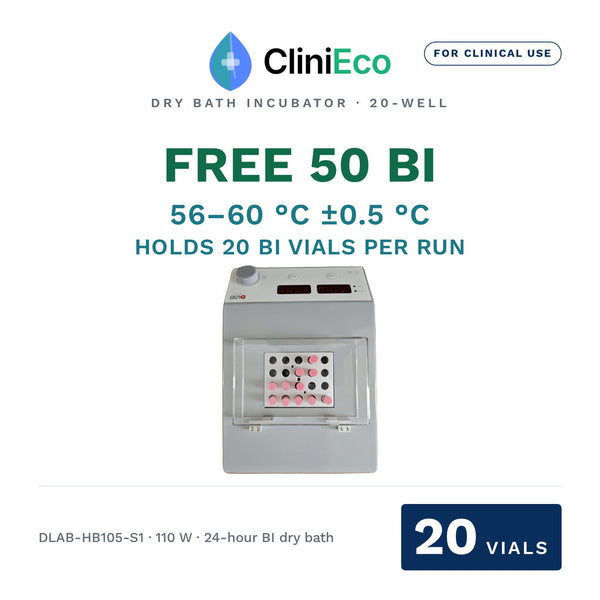
4–20 L ultrasonic · BI incubators · 4-well fluorescence reader · class B autoclave

Compliance kits & monthly pack
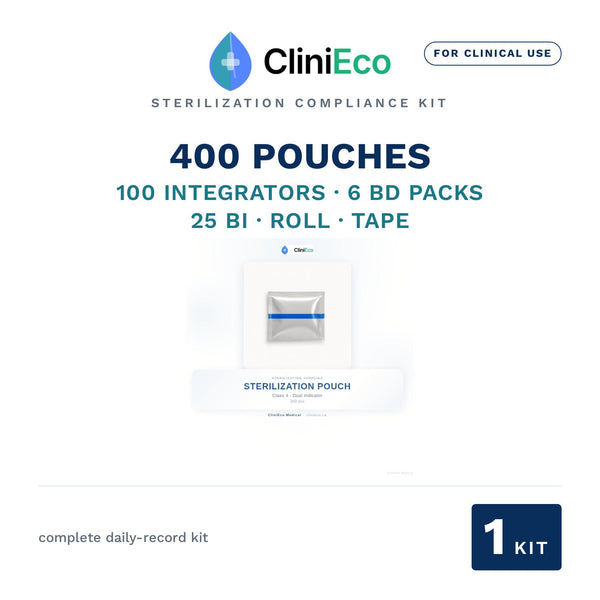
Pre-assembled kits and a monthly pack that map one practice's cycle volume onto a routine you can hand to an inspector.
pre-vacuum kit · gravity kit · assistant kit · monthly pack · starter bundle
Bench equipment is built to order — 3–4 weeks, confirmed before dispatch
Monitoring & verification
What proves the cycle actually worked — and where the record lands.
Packaging & sealing
Pouches and rolls sized to cassette length, plus the sealer that closes them.

Bench equipment
Cleaning, incubation and readout — the hardware that makes a record defensible.


Compliance kits
Pre-assembled kits that map one practice cycle volume onto a routine.

Biological indicator readout
Same spore strip, four readout windows. Pick by how fast you must release a load.
| Product | Readout | Tests per pack | Cycle type | Supplied as | Use |
|---|---|---|---|---|---|
| 20-minute rapid | 20 min | 50 | Steam, pre-vacuum | 50 per box | Fast release, high volume |
| 1-hour rapid | 1 h | 50 | Steam, pre-vacuum | 50 per box | Same-day turnaround |
| 3-hour rapid | 3 h | 50 | Steam, pre-vacuum | 50 per box | Next-morning release |
| 24-hour self-contained | 24 h | 25 / 50 / 100 | Steam, gravity or pre-vacuum | 50 per box · 25 / 100 options | Lowest cost per test |
Readout windows are set by the indicator type. Factory boxes hold 50 strips; the 25- and 100-test options are the same strip, split from or combined out of the same box. Lot CoA available on request.
Read before you buy
The reference library for this channel — six layers, from what the rules are to what an inspector opens first.
01Why sterilization is a compliance question
Federal / provincial / standards — who governs what
11 articles
Why sterilization is a compliance question
Federal / provincial / standards — who governs what
- Air Removal Testing on Pre-Vacuum Autoclaves: Daily Bowie-Dick Requirements
- Spore Test Frequency After a Major Sterilizer Repair and in Daily Practice: RCDSO, BC, CDC, AAMI ST79 and CSA Z314
- Is a Bowie-Dick Test Required Daily? Canada vs the US Requirements
- CSA Z317.2:24 Ventilation for Sterile Processing Areas: Air Changes, Pressure and Zoning in Canadian Health Care Facilities
- RCDSO Sterilization Monitoring Requirements Explained: Daily BI Testing in Ontario and What "Compliant" Really Means
- ISO 11607: Packaging Requirements for Sterile Devices
- ISO 11607 Explained: Packaging Requirements for Sterile Devices
- Cleaning and Disinfection SOP for a Pharmacy Sterile Compounding Room: Log Requirements
- Autoclave Tape Storage: Preserving Indicator Reliability
- CSA Z314 vs AAMI ST79: how each standard frames testing a sterilizer after a major repair
- CSA Z8000 and ASHRAE 170: Facility and Ventilation Requirements for Sterile Processing Areas Compared
02Audits & inspections
The five things an inspector opens first
8 articles
Audits & inspections
The five things an inspector opens first
- Sterilization Pouch Labels: What to Write and Why It Matters for Audits
- Autoclave Door Gasket and Chamber Inspection for Canadian Clinics
- Public Health Ontario Sterilization Log Requirements: What Inspectors Review
- What an Infection Control Auditor Checks About Gracey Curettes and Ultrasonic Scaling Tips
- What Auditors Check About Autoclave Tape in Quebec Clinics
- What Auditors Check About Autoclave Tape in Ontario Clinics
- What Auditors Check About Autoclave Tape in Canada Clinics
- What Auditors Check About Sterilization Roll in Quebec Clinics
03Monitoring & evidence
Physical / chemical / biological — what each one proves
21 articles
Monitoring & evidence
Physical / chemical / biological — what each one proves
- D-Value, Z-Value and SAL: Sterilization Validation Numbers
- ISO 11140-1 Explained: Chemical Indicator Classes and Where to Order in Canada
- Class 5 Chemical Integrators Explained: Load Release Basics
- Autoclave Indicator Tape: How It Works and Color Change
- How to Read Autoclave Tape: Understanding Chemical Indicators — Order in Canada
- Autoclave Indicator Tape: How It Works and Where to Buy It in Canada
- Class 4 vs 5 vs 6 Indicators in Canada: Which to Order + Free Printable Table
- Biological Indicator Failure: Recall, Root Cause, and Re-Test Protocol
- Where to Buy Chemical and Biological Indicators for Sterilization in Canada
- Sterility Assurance Level (SAL) Explained: What 10-6 Means — Buy Spore Tests in Canada
- Bowie-Dick vs Biological Indicator: What Each Test Catches
- Sterilization Acronyms: BI, CI, SAL and Bowie-Dick Explained
- Autoclave Tape vs Internal Chemical Indicators: The Difference
- Sterile Petri Dishes in a Clinic Lab: Handling, Labelling and Incubation Basics
- BI vs Chemical Indicators: What's the Difference in Sterilization Monitoring?
- Chemical Indicator Classes (ISO 11140-1): A Clinic Buying Guide
- Growth Control, Positive Control and Incubation Temperature in Spore Testing
- Spore Test Incubator Instructions: 57-60 C, 24 h, Read and Record
- Sterilization monitoring glossary: BI, CI, PCD and SAL explained
- How to Apply Autoclave Tape: Correct Placement on Instrument Wraps
- Sterility Assurance Level 10-6, Log Reduction and D-Value: What the Numbers Mean
04Process & packaging
Seven steps, seal parameters, loading errors
21 articles
Process & packaging
Seven steps, seal parameters, loading errors
- Why Do Sterilization Pouches Turn Brown or Spotty After a Cycle?
- What Is a Class B Autoclave? Chamber Design and Cycle Types
- Autoclave Cycles: Gravity vs Pre-Vacuum — Which Fits Your Load in Canada
- Sterilization Pouch Sizes: Fit, Seal and Common Errors — Order the Right Size in Canada
- Which Side Goes Up? Loading Sterilization Pouches — and Where to Buy Them in Canada
- Sterilization Pouch Sizes Chart: 3.5x10, 5x10, 7.5x13 for Canadian Clinics
- Instrument Tray Sterilization: Loading and Wrapping — Order Pouches in Canada
- Inside a Steam Sterilization Cycle: Phases, Timing and What to Order
- How to Load a Sterilization Pouch: Placement Tips — Order Pouches in Canada
- Sterilization Pouch Storage: How Long Sterile Packs Stay Valid — Order in Canada
- Reprocessing Workflow for Dental Offices: Washing, Packaging, Sterilizing and Storing Instruments Safely
- Autoclave Load Organization for Dental Practices: Best Practices
- Seal Integrity Testing for Sterile Pouches: ASTM F88, F1929 and F1886
- Dental Sterilization Equipment: Building the Washer, Sealer, Autoclave and Monitor Ecosystem
- Autoclave Pouch Workflow: Material, Indicator, Seal and Storage Decisions for Clinics
- How Do You Handle Power Outages During a Sterilization Cycle?
- Wet Packs After Autoclave Cycles: Which Drying Rules Apply in Canada vs the US?
- Autoclave Load Preparation Checklist for Steam Contact
- Dental Sterilization Room Setup: Pouches, Rolls, Tape and Indicators
- EN 868: What Sterilization Packaging Standards Require of Pouches and Reels
- Dark Water Spots and Brown Stains Inside Sterilization Pouches: Water Quality or Cycle Fault?
05Families & selection
Which BI window, how many pouches per chair
21 articles
Families & selection
Which BI window, how many pouches per chair
- Autoclave Bag & Pouch Sizes: Choosing the Right Dimensions
- Aseptic vs Sterile: The Distinction That Changes Your Clinic's Protocol
- What Solution to Use in an Ultrasonic Cleaner: Chemistry Options Compared
- Alcohol Prep Pads: Size, Saturation, and Sterility Guide
- Type N vs Type B vs Type S Sterilizers: Which Autoclave Fits Wrapped Instruments?
- Bacillus atrophaeus vs Geobacillus stearothermophilus: Which Spore Test for Which Cycle
- Type 5 Integrators vs Type 6 Indicators: Which to Order in Canada
- Ultrasonic Cleaner vs Manual Scrubbing: Which Prep Method Is Better?
- Chemical, Biological and Mechanical Sterilization Monitoring Compared: What Each Method Can Prove
- Enzyme vs Neutral Ultrasonic Cleaners: Which for Which Instrument?
- Self-Contained BIs vs Spore Strips and Ampoules: Formats Compared
- Enzyme vs Neutral Ultrasonic Cleaning Solutions: Which for Which Instruments
- Open vs Closed Gloving in a Veterinary Clinic: When Each Sterile Technique Applies
- Tongue Depressors: Sterile vs Non-Sterile Uses in Medical Exams
- Batch versus patient traceability: which records make a sterilization log audit-ready?
- Dental Cotton Swabs: Sterile vs Non-Sterile and What to Buy in Bulk
- Choosing Sterilization Pouch Sizes: A Fit Test and Stocking Strategy for Clinics
- Suture Removal Kits: Sterility and Selection for Clinics
- Which Sterilization Tape Belongs on the Pouch: Autoclave Tape or Indicator Tape?
- Sterile vs Sterilized vs Aseptic Explained — Where to Order Sterile Supplies in Canada
- Bowie-Dick Test Packs Compared: Which to Order in Canada
06Take it with you
Three printable A4 sheets
8 articles
Take it with you
Three printable A4 sheets
- How Long Do Sterile Items Stay Sterile? Free Printable Storage Checklist (PDF)
- Free Printable Autoclave Sterilization Log Sheet (PDF)
- Autoclave Maintenance Checklist: Daily, Weekly, Monthly — Order Supplies in Canada
- Clinic Sterilization Room Setup: Essential Supplies Checklist
- Free Printable Autoclave Log and Spore Test Record for Canadian Clinics
- ISO 25424: Low Temperature Steam and Formaldehyde Sterilization
- One ultrasonic cleaner and two autoclaves: where does the queue form?
- Sterile Processing Onboarding: A 31-Item Competency Checklist for Canadian Clinics
Take it with you
Print them, fill them, file them — the same three sheets our compliance kit ships with.
Pre-audit self-check
Nine questions every inspector asks, plus the Ontario daily-BI variable.
BI selection & frequency
Four readout windows against volume, with the provincial frequency note.
Autoclave Supplies & Sterilization Pouches
Why this category is different: every indicator we sell carries what an auditor asks for — organism, spore population, readout time, and lot number with expiry — so a pass can be traced back to the load it challenged. CliniEco Medical holds Health Canada establishment licence #35334 as an importer and distributor; ask us for the lot certificate of analysis for the lot you are buying and we will send the manufacturer's issued copy.
More about Autoclave Supplies & Sterilization Pouches
Autoclave supplies for a dental practice, organised as a category hub: pouches and rolls, indicator tape, spore-testing indicators, an incubator, a rapid reader and the sealer that closes the pack. The point of this page is selection and volume — which format fits which practice size, how the parts of a cycle fit together, and how to order by the case. Pouch sizes and seal evidence are set out on the sterilization pouches page.
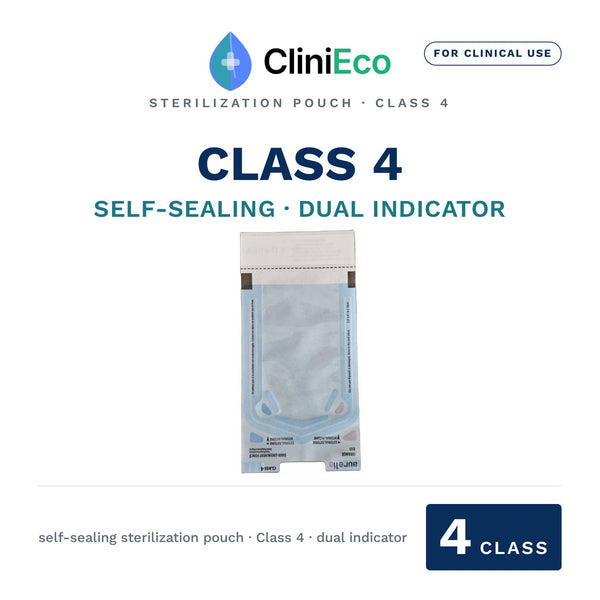
Start with the packaging that carries the load. A Class 4 self-sealing pouch with a dual indicator in a 200-per-box format is the pack most single-chair practices buy, with the heat-seal roll taking over once the practice is closing several packs a day.
What does a dental autoclave supply order actually cover?
Four jobs, in cycle order: cleaning the instruments, packaging and sealing them, marking the pack, and proving the cycle worked. Most practices treat these as four separate purchases and then discover that the pouch film, the sealer and the cycle have to agree before any of them is useful.
| Supply | Job in the cycle | Format as listed | Pack or case |
|---|---|---|---|
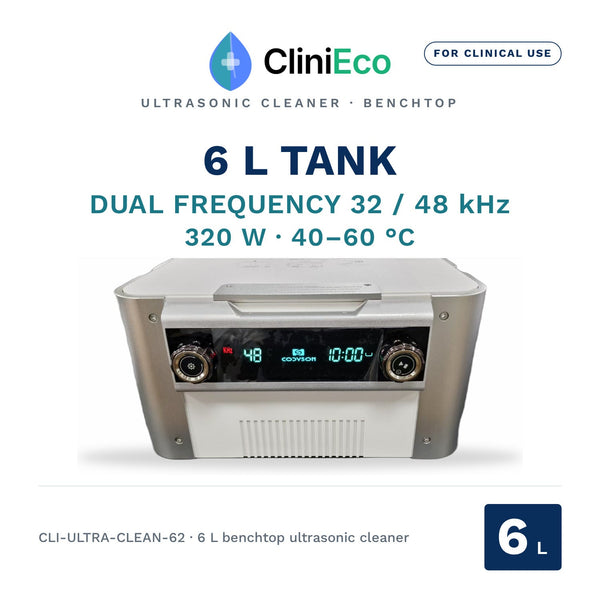
| Ultrasonic cleaner, CS6.2 | Cleaning before packing | 6 L benchtop, dual frequency 32/48 kHz | Single unit |
| Multi-enzyme cleaning solution | Bath detergent | Low-foam concentrate at 1:400 | 1 L bottle or 5 L pail |
| Class 4 self-sealing pouch | Packaging small sets | Dual indicator, paper and film | 200 per box, 2,000 per case |
| Heat-seal sterilization roll | Cut-to-length packaging | 76 mm x 50 m, Class 1 indicator | Case of 10 rolls |
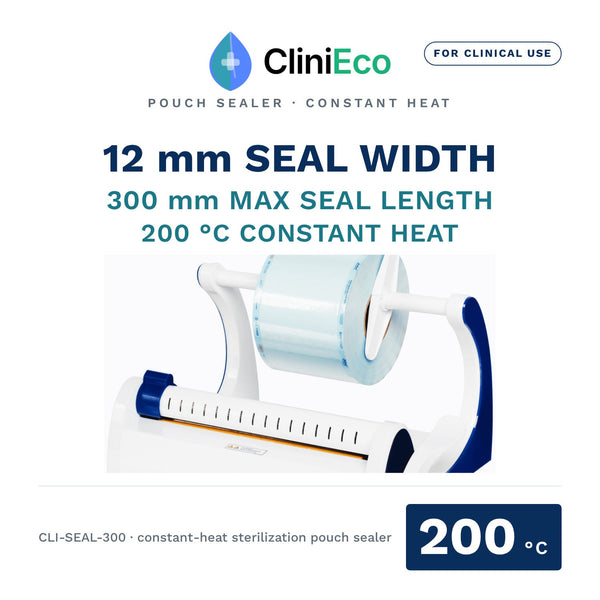
| Constant-heat pouch sealer | Closing roll or pouch | 200 C, 12 mm seam, 110 V | Single unit |
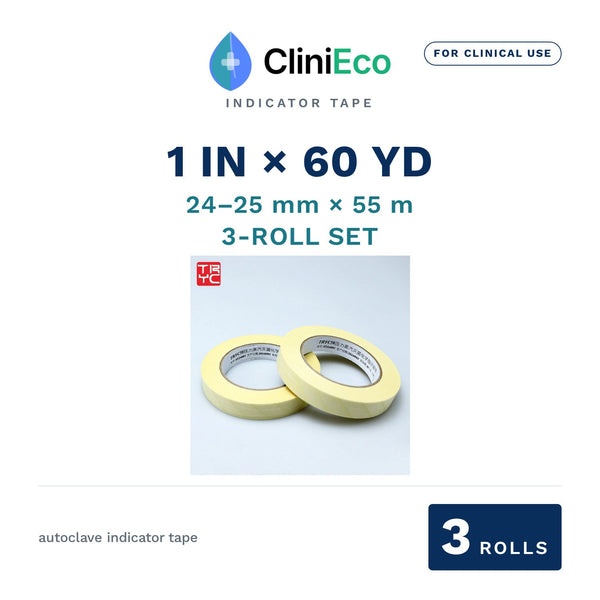
| Indicator tape | Sealing and labelling wraps | Class 1 stripes, 1 in x 60 yd | 3-roll set, case of 10 sets |
| 24-hour biological indicator | Spore test of the load | Self-contained vial, visual read | 25, 50 or 100 vials |
| 24-well dry-block incubator | Incubating 24-hour vials | 24 wells, 8.8 mm bores | Single unit |
The table is deliberately about formats, because that is where orders go wrong. A practice that buys a 12 mm sealer and then a roll cut for a different film width has two correct items that do not work together, and the failure only appears at the seam.
Which monitoring format fits a practice's daily cycle count?
Monitoring is sized to how long a load waits for an answer, not to how many instruments the practice owns. A practice that sterilises in the evening and releases loads the next morning can run 24-hour self-contained indicators: the vial goes into the dry block, incubates overnight, and is read before the first appointment. A practice that turns instruments over inside the same day needs a faster format, which means a fluorescence indicator and a reader.
The 24-hour indicator, 50-pack is the routine format for a single sterilizer, and the 3-hour fluorescence indicator is the same-day format for a practice that cannot hold a load overnight. The 4-well fluorescence reader covers the 20-minute, 1-hour and 3-hour readouts in one unit, so a practice that later changes readout time does not have to replace hardware.
Capacity is the second half of the decision. The 24-well dry-block incubator takes 24 standard self-contained vials in 8.8 mm bores, which is more than a single-chair practice will use in a week and about right for a clinic running two chambers with a daily test.
How many pouches and rolls does a practice use in a month?
Count packs, not instruments. One pack per instrument set, plus one pack for each loose item that cannot travel with a set, plus the occasional re-pack when a seal fails inspection. A single chair turning over eight to ten patients a day at one set per patient is 160 to 200 packs a month before re-packs, which is why a 200-per-box format and a 2,000-pack case exist as the two natural buying units.
Roll stock works the other way: a 76 mm x 50 m roll is cut to the length of the set, so the count is in metres rather than packs, and a case of ten rolls suits a practice that packs long or irregular instruments. Practices that do both usually keep one box of pouches for standard sets and one case of roll for everything else, rather than forcing every set into one format — the sterilization roll, 76 mm x 50 m is the roll format stocked here.
What changes between a one-chair practice and a multi-chair clinic?
Volume changes the order, and volume changes the monitoring cadence. A one-chair practice can run one chamber, one box of pouches and one box of indicators a month. A multi-chair clinic adds a second chamber, moves to case quantities, and starts needing a packaging station that is not the same bench as the sterilizer.
| Practice profile | Daily cycles | Packaging | Monitoring |
|---|---|---|---|
| Single chair, part time | Three to five | 200-per-box pouches, tape | 24-hour indicator in a dry block |
| Single chair, full time | Eight to twelve | Pouches plus one roll for long sets | 24-hour indicator, 50-pack |
| Two to four chairs | Fifteen to thirty | Pouch cases plus roll cases, second sealer | 3-hour readout in a 4-well reader |
| Multi-site or high turnover | Thirty or more | Case quantities with a par level per site | 20-minute readout, dedicated reader |
| Orthodontic or specialist | Mixed long and short sets | Roll-dominant, tape for wraps | 3-hour or 1-hour readout |
Read that table against the monitoring volume rather than the chair count. Each unit gets its own indicator on each test day, and the positive control is drawn in addition to the test vials, so a clinic that adds a second chamber nearly halves the life of a 50-vial box without changing anything about its patient load.
How do the sealer, the pouch film, the tape and the cycle fit together?
Three compatibility points decide whether a pack holds. The seam: a constant-heat sealer at 200 C produces a 12 mm seam, and that width has to match the film the pouch or roll was made for. The indicator: the tape is a Class 1 process indicator for the outside of the pack, while the pouch carries its own dual indicator, and neither of them is a biological indicator. The cycle: tape and pouch are rated for the steam cycles a dental autoclave runs, and packaging that is only rated for dry heat will not behave the same way in a steam chamber.
That is also why the tape belongs in the same order as the packaging. A roll of indicator tape seals a wrap, labels the pack and shows that the pack went through a cycle — three jobs that a practice notices only when one of them is missing.
How should a dental practice place a bulk order?
Order on a par level, not on an empty shelf. Set one number per item — boxes of pouches, rolls, boxes of indicators, rolls of tape — and reorder when the count reaches it. A practice that reorders at the point of use usually pays for an extra delivery, and a practice that orders once a quarter usually runs out of one item mid-quarter and reorders it on its own.
The wholesale purchasing desk handles clinic accounts, purchase orders and delivery for practices ordering by the case, which is the practical route for a clinic ordering desk that wants one invoice across packaging, monitoring and cleaning rather than three. For a practice setting up a program from nothing, the clinic starter bundle puts gloves, spore tests, packaging and tape in one shipment; for a first look at spore testing, the 5-pack trial is five test days for one unit.
Where do pouch sizes and pack counts live?
On the sterilization pouches page, which carries the size table, pack counts and seal evidence for each format. This page stays on selection by practice type and volume so the two do not repeat each other — read that page for the size decision, and this one for how many cases a practice of your size actually goes through.
For the record-keeping side, the sterilization log center holds a printable field set and the sterilization log generator on the same page; the field set includes the RCDSO 5542 fields used by Ontario practices, and practices in other provinces should check the field set their own college requires. The sterilization compliance consultation covers questions about how a cycle log, a pouch and a spore test fit the requirements a provincial regulator applies to your practice.
Related reading — Sterilization pouches: sizes, pack counts and seal evidence, pouch sealer validation records, and 24-hour biological indicators: pack sizes and incubation records.
Frequently Asked Questions about autoclave supplies
These are the questions a dental practice asks most often when it moves autoclave supplies onto one order.
How many autoclave pouches does a single chair use in a week?
Count one pouch per instrument set, plus a pouch for each loose item, plus the occasional re-pack when a seam fails inspection. A chair turning over eight to ten patients a day at one set per patient draws 40 to 50 pouches a week, which is why the 200-per-box format is the usual buying unit for a single chair and the case is the unit for a clinic.
Do I need both a dry-block incubator and a fluorescence reader?
Only if the practice runs both indicator families. A 24-hour self-contained vial is incubated in the dry block and read visually the next morning, while the 20-minute, 1-hour and 3-hour fluorescence formats are read in a reader. A practice that stays with one family needs one unit.
Can the same sealer close both rolls and pouches?
Yes, provided the film is compatible. A constant-heat sealer at 200 C lays down a 12 mm seam, and the roll stock and pouch stock sold alongside it are cut for that width. The sealer does not care whether the pack is a pouch or a cut length of roll; the film grade is what decides the result.
What does indicator tape prove about a cycle?
It proves the pack was exposed to a sterilisation process, which is why it is a Class 1 process indicator and belongs on the outside of every pack as a label as well as a check. It does not prove the load reached temperature, and it never replaces a biological indicator.
What does the clinic starter bundle cover?
Four consumables a new program consumes every week: gloves, spore tests, pouches and indicator tape, in one shipment. It is a first-order format for a practice setting up a sterilization program, not a replacement for the incubator or reader that the spore testing depends on.
What is the minimum order?
There is no minimum: a single box or pack can be ordered. Freight is charged per shipment rather than per box, so most practices move to the case format as soon as their monthly volume is known — one shipment carrying several case formats works out cheaper per unit than several small parcels.
Do you ship across Canada?
Yes. Orders ship from our Toronto warehouse to every Canadian province and territory. Stock items dispatch in 2–3 business days; bench equipment is built to order and carries a longer lead time, which we confirm when the order comes in.
Can I get a lot-specific CoA?
Yes, on request. The lot number is printed on every box, and the certificate of analysis is issued against that lot. Quote the lot number from the box, or ask for it with the order, and we send the CoA for that specific lot.
What is the shelf life and how should it be stored?
Shelf life is set per product family and is printed on each box as a lot number and expiry date; use the date on the box rather than a generic figure. Store sealed stock in a dry, dust-free place away from direct sunlight and heat, and keep sterile packs out of the sterilisation room, where steam and heat cycle daily.
Importer and distributor: CliniEco Medical — Health Canada establishment licence #35334. Formats and pack counts here follow the live listing for each item; confirm cycle ratings against your sterilizer's own documentation before changing packaging.