
Prism Dental Loupes in Canada
What these loupes are
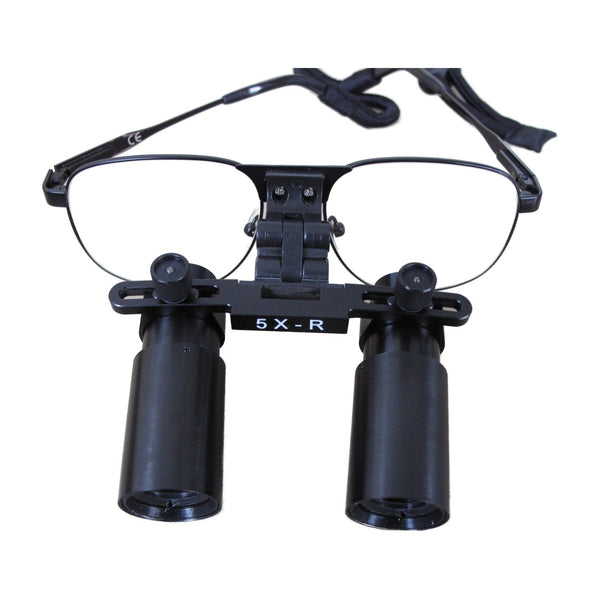
Prism loupes put a prism group behind the objective so the field stays wide and steady while your posture drifts — which is what makes higher magnification usable for procedures that run for hours rather than minutes. This collection runs from a 3.5× flip-up pair through 5×, 6× and 8× barrels: the 3.5× entry point is where prism optics can be compared directly against Galilean ones at the same magnification, and the higher powers are where the design earns its keep. All pairs have adjustable interpupillary distance, a working distance chosen at order, and no fitting appointment.
-
5 options$498.00
$597.00CAD -
5 options$682.00
$819.00CAD




Specs at a glance
Five configurations are listed. The two 3.5× pairs share optics and differ only in whether the wireless headlight is in the carton; the 5×, 6× and 8× are separate barrels with their own working-distance settings.
| Magnification | Working distance | Field of view | Weight | Headlight |
|---|---|---|---|---|
| 3.5× — flip-up prism, loupes only | 340 / 420 / 460 / 500 / 550 mm, one at order | ≈80 mm at 400 mm | ≈70 g with optics | Not included |
| 3.5× — flip-up prism, headlight set | Same five settings, one at order | ≈80 mm at 400 mm | ≈70 g plus 11.8 g lamp head | 32,000 lux at 40 cm |
| 5× — prism barrel | 340 / 420 / 500 / 550 mm, one at order | Narrower than 3.5×; confirmed for your setting | Confirmed at order | Mount accepts the headlight |
| 6× — prism barrel | Same four settings, one at order | Narrower again; confirmed for your setting | Confirmed at order | Mount accepts the headlight |
| 8× — prism barrel | Same four settings, one at order | The tightest field in this collection | Confirmed at order | Mount accepts the headlight |
Two rows are deliberately incomplete. Frame weight and field of view for the 5×, 6× and 8× barrels are confirmed against the working-distance setting you order rather than published as a single number, because both change with that setting and a figure quoted at 340 mm would be wrong at 550 mm. We would rather answer that question for the pair you are buying than print a number that only holds at one distance.
How to choose your magnification
Prism optics are not a free upgrade — they are a different trade. At the same 3.5× the prism field is about 80 mm at 400 mm against roughly 65 mm on the Galilean pair, and the difference is not the magnification: it is that a prism group holds that width when you lean in, where a Galilean pair narrows as you tilt. That property is what makes 5× and above practical. Without it, higher magnification means a field that changes size every time your head moves, and the clinician spends the appointment repositioning instead of working.
The cost is depth of field. Each step up the barrel thins the in-focus zone, so a 6× or 8× pair is unforgiving about a patient's head drifting or your own posture shifting. Those powers belong to endodontics, microsurgical work and fine prosthetic margins — not to a general exam. 5× is the common landing point for clinicians who want more than 3.5× but still work across a quadrant; 8× is a single-purpose instrument.
Three pairs to compare: CliniEco Prism Dental Loupes — 5× Magnification, Adjustable is the usual first step above 3.5×; CliniEco Prism Dental Loupes — 6× Magnification, Adjustable is the endodontic workhorse; and CliniEco Prism Dental Loupes — 8× Magnification, Adjustable is the highest power in the collection. If you are comparing at 3.5× instead, the entry point to this collection is the flip-up pair in the table above, and the straight Galilean equivalent at the same power is in the Galilean loupes collection.
Which magnification do most Canadian dental clinics use?
In both Canada and the United States, most clinics operate between 2.5× and 3.5×, and prism barrels above 4× remain specialist instruments rather than standard equipment. The buying difference between the two countries is the regulatory route rather than the demand: Canadian clinics buy this class of device through a licensed importer under the Medical Devices Regulations, while American clinics buy through a separate registration pathway, which is why equivalent optics arrive with different paperwork. The magnification distribution at the chair is close to identical.
Within a practice, the pattern is one pair per clinician rather than one pair per room, because a barrel set to your working distance is uncomfortable for someone whose sight line differs by 100 mm. That is the practical argument against sharing 6× or 8× between two people with different seating postures.
Do you need a headlight?
At 5× and above, the working distance is shorter and the site is often deep, so the light becomes part of the instrument rather than an accessory: a 32,000 lux headlight at 40 cm on an 11.8 g lamp head with three hot-swappable USB-C batteries keeps the illuminated patch aligned with a field that has narrowed. Colour rendering matters as much as output at these powers — a colour rendering index of 90 or above keeps tissue and margin tones distinguishable under magnification, where a low-index light flattens them.
For a 3.5× prism pair used across exams and restorative work, the light is optional in the same way as on any 3.5×; add it when posterior or surgical sites are part of the day.
When does a prism design earn its extra weight?
Above 4×. A two-element Galilean system stops at 4×, so every step beyond that — the 5×, 6× and 8× pairs in this collection — is prismatic by construction. What the prism group buys is a field that stays wide and steady while your posture drifts, which is what makes high magnification usable across a long procedure rather than for a single look. If the caseload is examinations and hygiene at 2.5× to 3.5×, a lighter Galilean pair does the same job.
Which three measurements decide the fit of a prism pair?
Working distance, pupil distance and prescription. Working distance is fixed per pair and chosen at order from four settings — 340, 420, 500 and 550 mm — measured from your eyes to the work surface in your working posture. Pupil distance stays adjustable on the frame after delivery. Prescription is the one buyers forget: at 5× and above the view tolerates less error, so an insert that sits slightly off centre shows up sooner than it would on a 2.5× pair.
Where does a prism pair go if it needs service?
Ask before the order, because the route differs by design: some optical service is carried out inside Canada, and some barrels have to return to the optical supplier. Get the answer in writing with the turnaround expressed in weeks. The commercial terms are published — orders are processed in one to two business days from Toronto, and unopened sets can be returned within 30 days against a Return Authorization number, with refunds processed five to seven business days after receipt.
Next step
Decide the working distance first, then the magnification, then whether the light is in the carton. The long-form comparison of designs, field widths and what each step costs in working feel is in the dental loupes buying guide for Canadian clinics. If posture rather than field is the problem you are solving, start with the angled loupes collection instead.
CliniEco Medical is a Health Canada licensed importer and distributor — MDEL #35334 — shipping from Toronto.