
For Home Care
Home healthcare essentials — gloves, masks, first aid supplies, incontinence care, and daily living aids.
Buying for one person at home is a different arithmetic from buying for a floor. The quantity has to survive a change of routine — an extra night change, a bad week, a second carer — without leaving a cupboard full of a size nobody uses any more. Three items set that arithmetic: briefs, underpads and gloves. Each is sold by the case with a stated inner pack count, so the reorder interval can be worked out before the first order instead of after the third.
- Bulk Case (120 Pack)$170.00
$200.00CAD



More about For Home Care
How many briefs does one person use in a 30-day month at 5 or 6 changes a day?
Start from the change count in the care plan and multiply. Five changes a day over thirty days draws 150 briefs; six changes a day draws 180. A case of the CliniEco Adult Pull-On Diapers — Incontinence Briefs, Maximum holds 120 briefs as six packs of 20, so five changes a day gives 24 days from one case and six changes a day gives 20. A household on the six-change routine is therefore ordering again inside the month, and the order point belongs at the last week of cover rather than at the last pack.
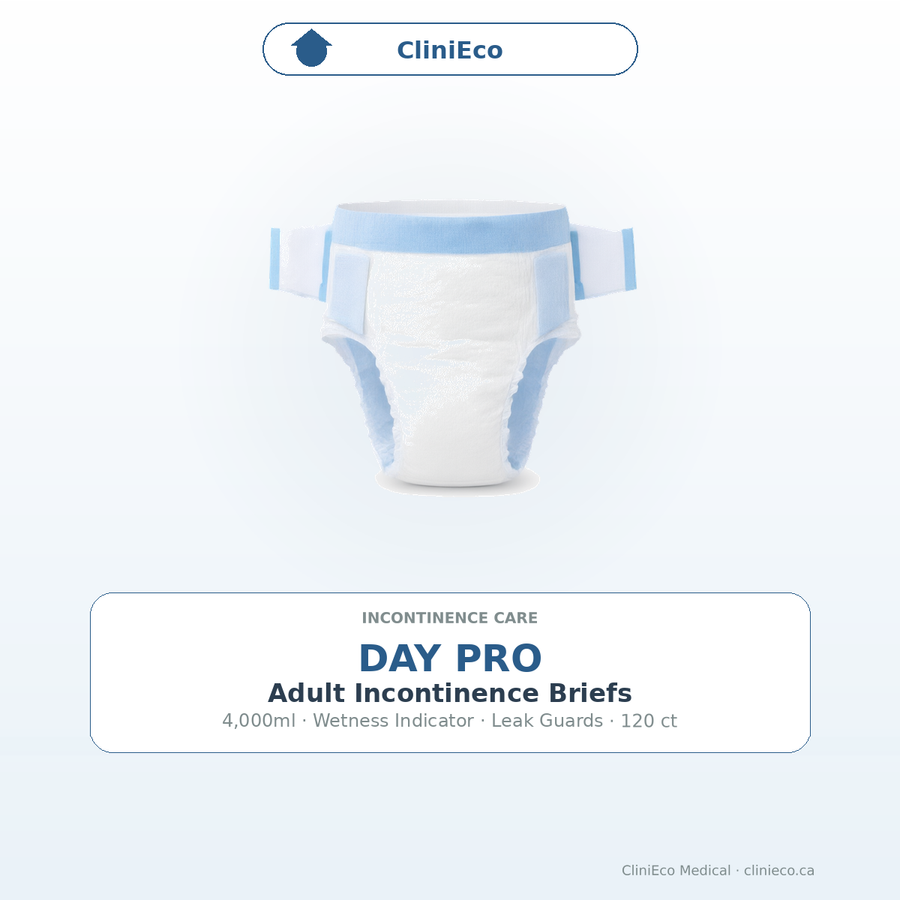
Pull-on format suits the person who still walks to the washroom: it goes on like underwear and there are no tabs to line up or re-stick. Where the change happens with the person lying down, a taped brief is the format that can be opened, checked and refastened. Both are sold as a case of 120 in six packs of 20, so the arithmetic does not change when the format does.
How many underpads does one bed use, and how long does a box of 50 last?
An underpad protects the mattress, chair or bed rail, and it is changed at the same time as the brief rather than instead of it. One bed on two night changes draws 14 pads a week. The CliniEco Medical Adult Underpads 60×90cm — 500 ct (10-Box Case) arrives as ten boxes of fifty, so one box covers about three and a half weeks at that rate and a case covers roughly thirty-five. The box is the unit kept beside the bed; the case is the reserve behind it.
How many gloves does 30 days of home care use at 5 changes a day?
A change takes one pair, so the glove count follows the change count doubled. Five changes a day is ten gloves a day, and the CliniEco Medical Nitrile Gloves — 3.5mil Standard, Blue, 1,000 Gloves (10-Box Case) gives a thousand gloves as ten dispenser boxes of a hundred, which is about a hundred days at that rate. Two carers sharing the routine double the draw and halve the cover to fifty days. Sizes S, M, L and XL each ship as their own case, so a household buying a single size for two pairs of hands will run short at the smaller or the larger end first.
Which pack count should the reorder point be built on?
| Item | Pack and case count | Basis per change | One case covers |
|---|---|---|---|
| Pull-on briefs | 120 per case, six packs of 20 | One brief | 20 to 24 person-days at six or five changes |
| Taped briefs, 4,000 ml | 120 per case, six packs of 20 | One brief | 20 to 24 person-days at six or five changes |
| Underpads, 60 × 90 cm | 500 per case, ten boxes of 50 | One pad per change | About 250 changes, or 35 weeks at two a night |
| Nitrile gloves | 1,000 per case, ten boxes of 100 | Two gloves | About 100 days at five changes a day |
Read the table as a multiplier, not as a stock list. Take the changes a day from the care plan, multiply by the basis per change, and divide each case count by the result. The line that runs out first is the one whose case count divides by the smallest number, and in most homes that is the brief at 120 units: a change consumes one brief, two gloves and often one pad, so the brief reaches the reorder point several weeks ahead of the glove case.
What belongs on the supply sheet on the cupboard door?
Five columns are enough: item, pack and case count, changes a day, days one case covers, order-when-remaining. The pack count should be read off the product page rather than from memory, because the number printed in the web address of a listing is not always the number in the pack. The days-per-case column is the one worth recalculating whenever the routine changes, and the order-when-remaining column turns that figure into a date a family can act on instead of a guess made under pressure.
When is a second format worth carrying?
Two formats usually earn their shelf space for different reasons: a pull-on for daytime independence and a taped brief for the stretch when the person is in bed. Carrying both is not duplication if each one has a named use on the care plan, but each carries its own case of 120, so a household holding both is holding 240 briefs and should measure the storage and the shelf life against that before ordering the second case. The same test applies to the underpad: one size for the bed and one for the chair is reasonable, three sizes for the same bed is stock that ages.