
For Dental Clinics
What a Canadian dental practice actually orders — chairside consumables, instrument reprocessing equipment, sterilization monitoring and the magnification a clinician wears all day. Twenty-nine published listings sit in this collection, and they are not one shopping list: a bib and a biological indicator are bought on different schedules, from different budgets, and for different reasons. The page below maps the collection by section, then answers the monitoring question that differs most between Canada and the United States.
-
Sterilization & Infection Control > Steril...$69.99
$99.00CAD -
Sterilization & Infection Control > Steril...$699.00
$839.00CAD -
Sterilization & Infection Control > Steril...$499.00CAD
-
Dental & Oral Care > Dental Equipment$329.00
$485.00CAD -
2 options$399.00
$479.00CAD -
Sterilization & Infection Control > Steril...$379.00
$391.00CAD -
Sterilization & Infection Control > Steril...$189.00CAD
-
Photo pending CliniEco Universal Dental Adhesive — MDP Single-Bottle, Light-Cured, 5mL (Coming Soon) · Dental & Oral Care > Restorative & Impression · SKU CLI-DEN-ADH-U05
-
Photo pending CliniEco Dual-Cure Self-Adhesive Resin Cement — Automix Syringe, 6g (Coming Soon) · Dental & Oral Care > Restorative & Impression · SKU CLI-DEN-CEM-SA6
-
Dental & Oral Care > Restorative & Imp...$99.99CAD
-
10 Bags (1,000 Ejectors)$53.91CAD
-
Bundles & Subscriptions > Monthly Supply, ...$129.99CAD
-
Dental & Oral Care > Dental Equipment$699.00
$1,073.00CAD -
Sterilization & Infection Control > Steril...$349.00CAD
-
Sterilization & Infection Control > Steril...$109.99CAD
-
Sterilization & Infection Control > Steril...$249.99CAD
-
Bundles & Subscriptions > Monthly Supply, ...$1,499.00CAD
-
Sterilization & Infection Control > Steril...$1,499.00CAD











More about For Dental Clinics
What is in this dental clinic collection?
Twenty-nine published listings in four sections. Formats and pack counts are those printed on the current listings; two lines are shown in advance of stock and each product page states its own status.
| Listing | Section | Supplied as |
|---|---|---|
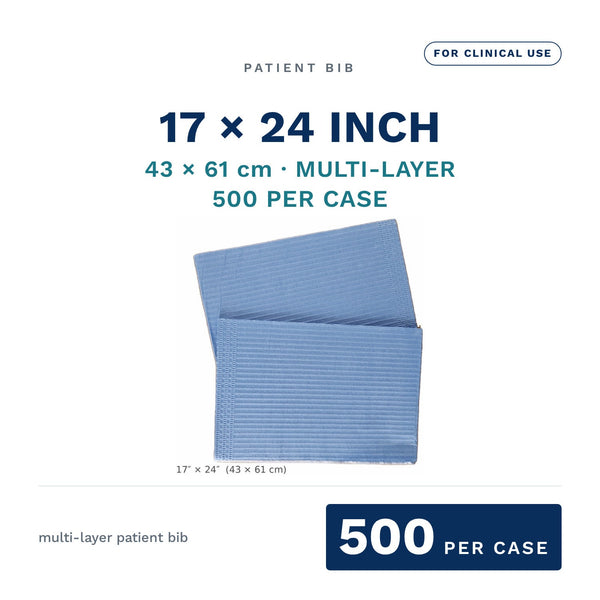
| Aurelia patient bibs, 17 in × 24 in | Chairside | 500 per case; ten colours |
| Dental bibs, 3-layer paper and PE | Chairside | 500 per pack; 4-box case of 2,000 |
| Surgical mask, individually wrapped, 3-ply | Chairside | 50 per box; 10-box case of 500 |
| Face shield, anti-fog, individually wrapped | Chairside | 24 per box; 10-box case of 240 |
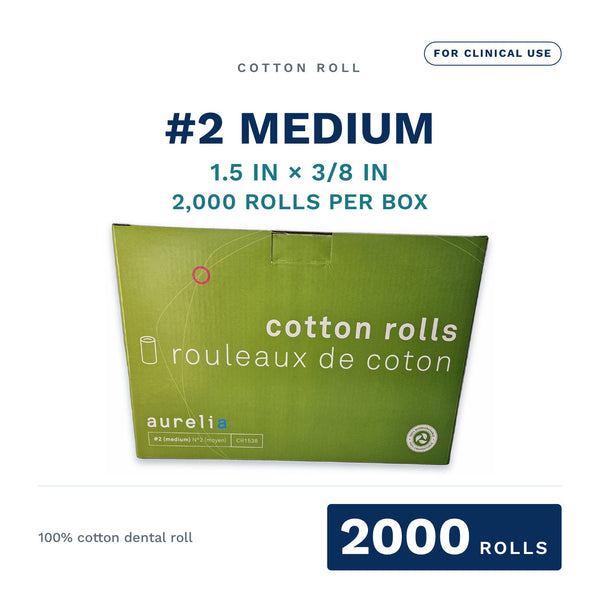
| Cotton rolls, #2 medium | Chairside | 1.5 in × 3/8 in; 2,000 per box; 12-box case |
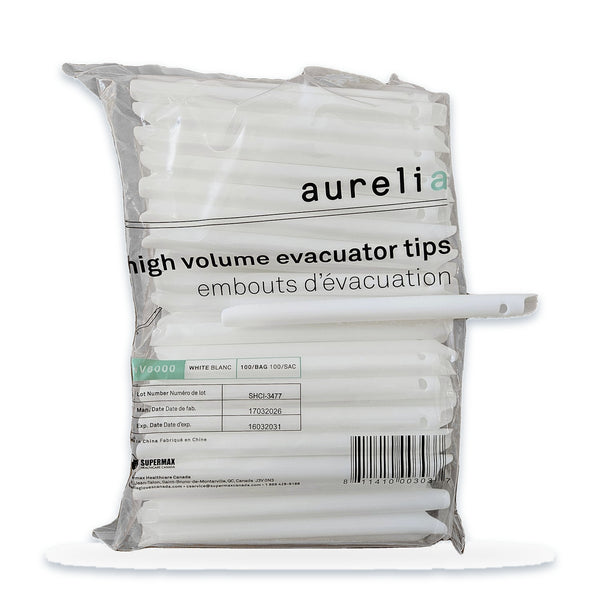
| High-volume evacuator tips | Chairside | 100 per bag; 10-bag case of 1,000 |
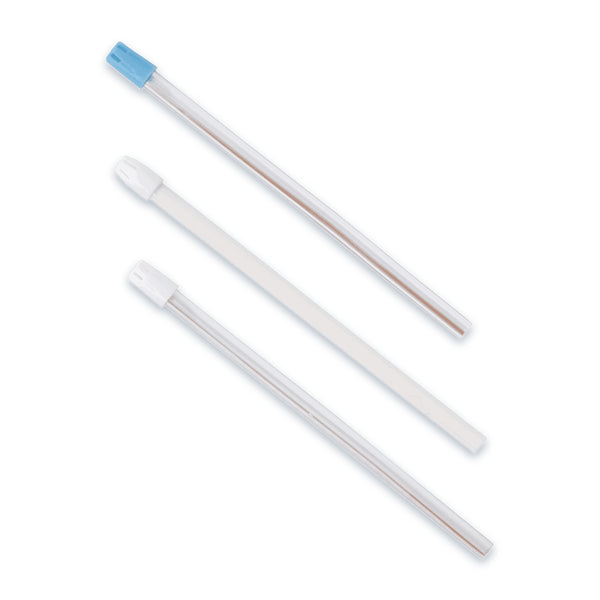
| Saliva ejectors | Chairside | 100 per bag; 10-bag case of 1,000 |
| Tongue depressors, birch wood | Chairside | 100 per bag; 10-bag case of 1,000 |
| Exam table paper, 21 in | Chairside | 125 ft perforated roll; 9-roll pack |
| X-ray bite blocks | Chairside | 100 per pack; 2-pack case |
| Dental dam, latex, 6 in × 6 in | Chairside | 52 sheets per box |
| Alginate impression material | Chairside | 1 lb canister |
| Dual-cure self-adhesive resin cement | Chairside | 6 g automix syringe |
| Universal dental adhesive, MDP | Chairside | 5 mL single bottle |
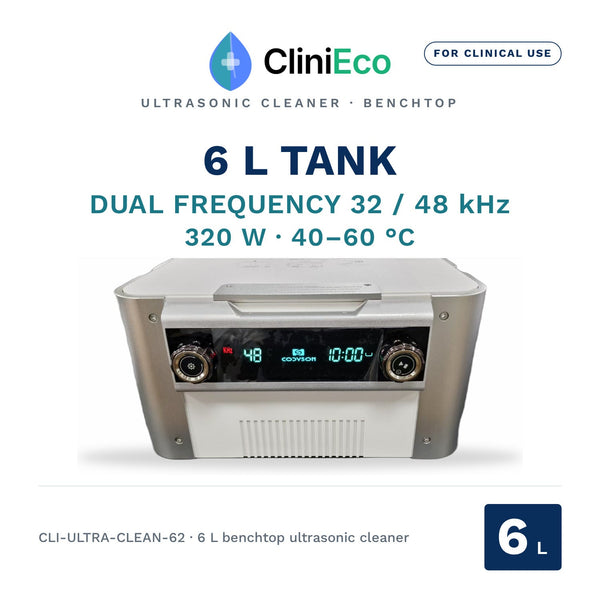
| Ultrasonic cleaner, 6 L | Reprocessing | Benchtop unit, dual frequency 32/48 kHz |
| Constant-heat pouch sealer | Reprocessing | 200 °C, 12 mm seal, 110 V |
| Clinic starter bundle | Reprocessing | Gloves, spore testing and packaging in one bundle |
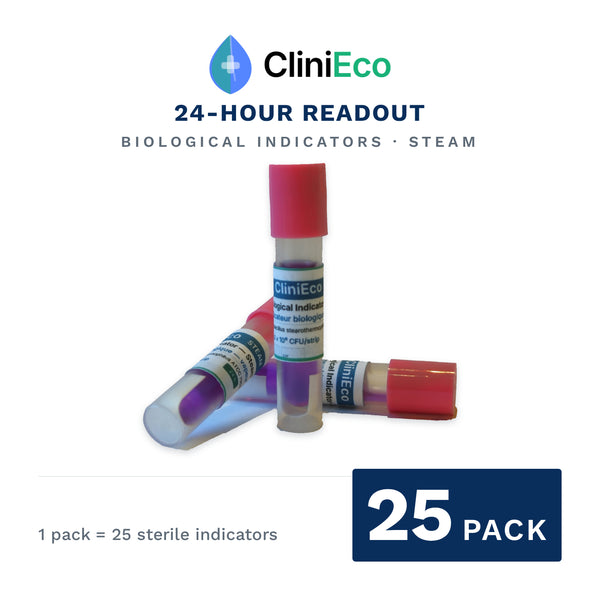
| Biological indicator, 24-hour readout, 25-pack | Monitoring | 25 self-contained indicators |
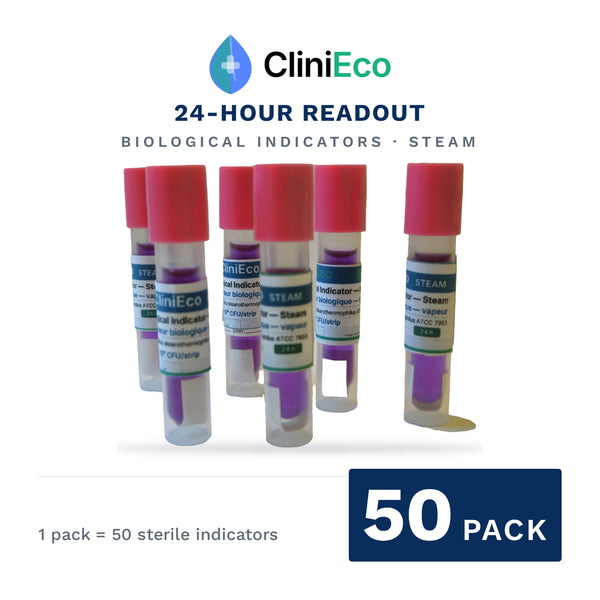
| Biological indicator, 24-hour readout, 50-pack | Monitoring | 50 self-contained indicators |
| Biological indicator, 24-hour readout, 100-pack | Monitoring | 100 self-contained indicators |
| Biological indicator, 3-hour fluorescence readout | Monitoring | 50 per pack |
| Biological indicator incubator, dry block | Monitoring | 24 wells |
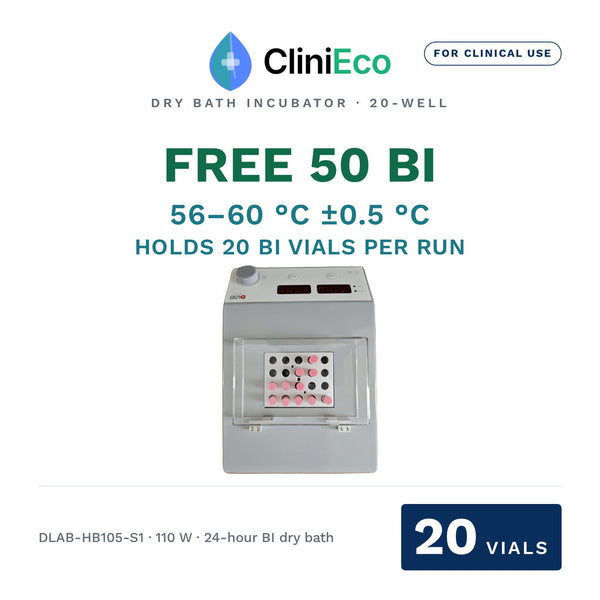
| DLAB dry bath incubator with lid | Monitoring | 20-well block |
| Rapid reader, 4-well fluorescence | Monitoring | 20-minute, 1-hour and 3-hour readout |
| Rapid reader seed trial | Monitoring | Trial listing — see the product page for terms |
| Flip-up dental loupes, 2.5× | Vision | Flip-up prism optics, adjustable |
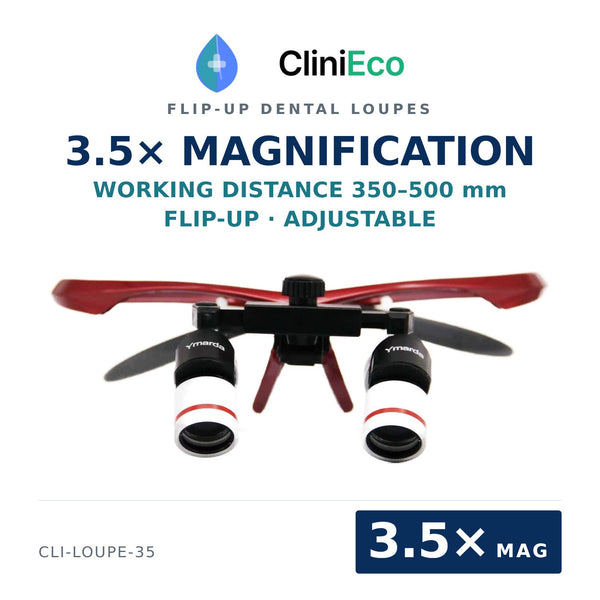
| Flip-up dental loupes, 3.5× | Vision | Flip-up prism optics, adjustable |
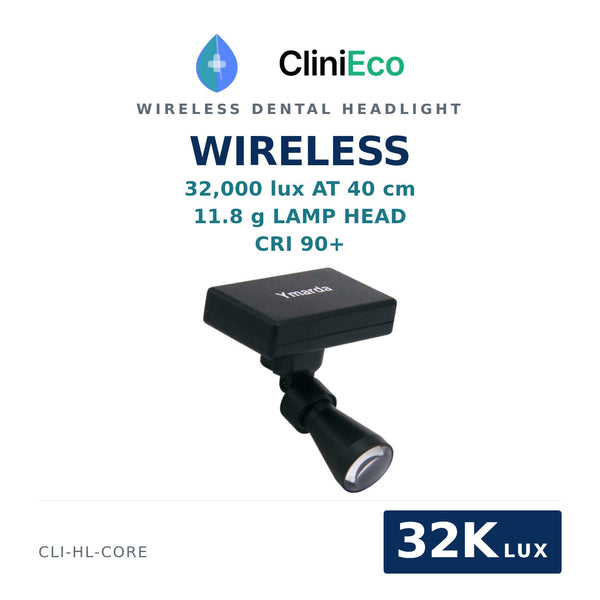
| Wireless dental headlight, Core | Vision | 32K lux, ultra-light, for loupes |
| Wireless dental headlight, Pro | Vision | Dual battery |
One further cotton roll listing is in the collection but not published, so it is not linked: a 2,000-roll box variant of the same #2 medium roll. Until it is live, the published route is the two-box and twelve-box listing above.
How often must an Ontario dental practice run a biological indicator?
Every day the sterilizer is used, and for each type of cycle used that day. The Royal College of Dental Surgeons of Ontario's infection prevention and control standard expects a biological indicator in a process challenge device for each sterilizer on each day it runs, and Public Health Ontario's guidance uses the same construction. The test attaches to the unit and to the cycle, not to the clinic, so two sterilizers running steam on the same day produce two results.
The weekly cadence that circulates widely is the American baseline, not the Ontario one: the CDC's disinfection and sterilization guideline and AAMI ST79 both set at least weekly monitoring for steam sterilizers, with daily testing preferred where a unit is used frequently. A policy copied from a United States checklist will therefore pass an internal review and still fail the record an Ontario inspector asks to see. The practical consequence is arithmetic: a five-day week across fifty working weeks is roughly 250 monitoring opportunities per sterilizer per year, not the 52 a weekly schedule implies.
Outside routine monitoring, the moments that need an indicator are the ones where the process has changed: after a major repair, after relocation, and after a malfunction, with the loads held until the result is known. Whichever schedule a practice writes, the practice has to set it by the stricter of its provincial regulator and its own policy, and document which document it is following.
Which monitoring items does each sterilizer need, and which standard covers each?
Three layers, and they answer three different questions. Mechanical monitoring reads the sterilizer's own time, temperature and pressure on every cycle — it shows the machine did what it was told. Chemical indicators show that a package was exposed to the process; ISO 11140-1:2014 is the general requirements document, and the type numbering in that edition runs from process indicators through to integrating indicators, with the types not ranked as a hierarchy. Biological monitoring uses spores to show the cycle actually killed; ISO 11138-1:2017 sets the general requirements for producing, labelling and testing those indicators.
Only the biological result speaks to lethality. A pouch that changed colour proves exposure, and a display that reads correctly proves the machine's own sensors agreed with the set point; neither proves that the load is sterile. That is why the record an inspector wants has a column for each layer rather than one line per day.
In Canada the reprocessing framework these items serve is the CSA Z314 series, currently CSA Z314:23; in the United States it is ANSI/AAMI ST79. Both are written around the same ISO indicator standards, which is why the consumables travel and the cadence does not.
How does readout time change the daily routine?
A 24-hour readout indicator is incubated overnight and read the next working day; a 3-hour fluorescence indicator is read inside the same shift. The choice is a workflow decision before it is a cost decision, because the read time determines when a load can be released and how many incubator slots a week of testing consumes.
The arithmetic is simple and worth doing before ordering. A practice with two sterilizers testing every operating day generates ten indicators a week; a 24-well dry block holds two weeks of that, which means one incubation run a week closes the book. A 20-well unit holds exactly one week plus a spare, so it has to be emptied on schedule rather than whenever it fills. A practice that moves to a 3-hour readout halves the delay but still needs a reader and a slot for every test.
Does a biological indicator run on the same schedule in Canada and the United States?
No, and this is the difference that most often reaches an inspection. In Ontario the standard is set by the provincial regulator: a biological indicator for each sterilizer on each day it is used, and for each cycle type used that day, which the RCDSO standard states and Public Health Ontario's guidance repeats. In the United States the baseline is at least weekly for steam sterilizers under the CDC guideline and AAMI ST79, with daily testing preferred where a unit is used often.
Neither schedule is a quality ranking; both catch a failing sterilizer. What differs is the record an inspector asks for, which is why a policy copied across the border does not survive a Canadian audit.
What does one operatory consume in a month?
Start from the packs rather than from an average. A bib pack of 500 covers roughly a month of chairside work for one room at twenty patients a day; a box of 50 individually wrapped masks is a week at that volume; a 100-tip bag of evacuator tips and a 100-ejector bag run out at about the same rate, which is why they are bought on the same order line. Cotton rolls arrive in boxes of 2,000 and cases of twelve boxes, so the inner box is the working unit. Dam sheets come 52 to a box, and a box is the unit a restorative-heavy operatory tracks.
Two items sit outside that rhythm. Table paper is a roll of 125 feet perforated at exam length, and the 9-roll pack is a quarter's supply for a single room. Alginate is a 1 lb canister with a working time that depends on the water temperature and the mixing ratio, so it is bought against the impression schedule rather than against the patient count.
How does the framework for a dental practice differ between Canada and the United States?
Two regulators, two standards, two cadences — and only one of the three differences is a matter of quality rather than paperwork. The reporting structure is otherwise similar: a documented result per sterilizer per monitoring event, with a corrective action where a result is positive.
| Item | Canada | United States |
|---|---|---|
| Reprocessing standard | CSA Z314:23, Canadian medical device reprocessing | ANSI/AAMI ST79:2017, comprehensive guide to steam sterilization |
| Biological monitoring cadence | Ontario: every day the sterilizer is used, for each cycle type (RCDSO standard; PHO guidance uses the same wording). Other provinces set their own. | At least weekly for steam sterilizers, daily preferred where the unit is used frequently (CDC guideline; AAMI ST79) |
| Biological indicator specification | ISO 11138-1:2017 | ANSI/AAMI/ISO 11138-1:2017 (R2024), the United States adoption of the same ISO edition |
| Chemical indicator specification | ISO 11140-1:2014 | ANSI/AAMI/ISO 11140-1:2014 (R2025) |
| Labelling | English and French | English |
The cadence row is the one to carry into a policy document. A Canadian practice that writes weekly because a template said so has a policy that disagrees with its own regulator, and the gap surfaces during an inspection rather than before it.
A practice ordering for several locations has a second question beyond the cadence: whether the same pack size travels across sites. Multi-site accounts start at the institutional account enquiry page, where the order is built per site rather than pooled.
Related reading
The collection is one of several that a dental practice orders from. Related collections: clinic supplies, cleaning and disinfecting, autoclave and ultrasonic equipment, autoclave supplies and pouches, and autoclave monitoring and spore testing.
Background on the monitoring questions in this collection: how often to spore test a dental office under the RCDSO standard, RCDSO and Public Health Ontario guidance compared, and annual spore testing cost for a Canadian dental clinic.
Frequently asked questions
Is weekly biological monitoring enough for an Ontario dental practice?
No. The RCDSO standard expects a biological indicator for each sterilizer on each day it is used, and for each cycle type used that day. Weekly is the CDC and AAMI ST79 baseline in the United States, not the Ontario requirement.
Does one biological indicator cover two sterilizers used on the same day?
No. Monitoring attaches to the unit and to the cycle type, so two sterilizers running steam on the same day need two results, and each result is recorded against its own sterilizer identifier.
What does a chemical indicator prove that the sterilizer display does not?
The display reports the machine's own sensors for that cycle; a chemical indicator reports what the package itself experienced. Neither is a substitute for the biological indicator, which is the only one of the three that tests lethality.
How many indicators does a two-sterilizer practice use in a year?
At five operating days a week across fifty weeks and one cycle type per unit, roughly 500 — about 250 per sterilizer. The pack sizes in this collection are chosen so that arithmetic converts to whole packs.
Where does a practice start with a monitoring routine?
With the number of sterilizers and the cycle types actually used. The compliance log centre carries the printable sterilization log and the log generator, the clinic supply planner converts clinical days into packs, and the compliance consultation desk answers the province-specific questions.
Standards and sources
Editions and links were checked on 6 November 2026. Royal College of Dental Surgeons of Ontario, infection prevention and control resources; Public Health Ontario, infection prevention and control for clinical office practice; ISO 11140-1:2014, chemical indicators for sterilization; ANSI/AAMI/ISO 11138-1:2017 (R2024), biological indicators; CSA Z314:23, Canadian medical device reprocessing in all health care settings; CDC, guideline for disinfection and sterilization in healthcare facilities. The CDC and CSA pages refuse automated requests; both documents were cited from their published catalogue and guideline records.
Distribution: CliniEco Medical — MDEL #35334. Formats and pack counts are those printed on the current product listings; confirm the monitoring cadence against the provincial regulator's current standard before writing a policy.