
Equipment
Equipment is the part of a clinic build-out that gets decided late and paid for early. The lease is signed, the rooms are drawn, and then someone has to answer a deceptively simple question: what has to be on the bench before the first patient is seen, and what can wait a year. This page is the entry point for that decision — what each group of equipment does, which room it belongs in, and what has to be in place in Canada before a device can be used at all.
- $699.00
$839.00CAD - 2 options$399.00
$479.00CAD - $379.00
$391.00CAD


-
Sterilization & Infection Control > Steril...$349.00CAD
-
5 options$699.00
$839.00CAD -
Sterilization & Infection Control > Steril...$3,999.00CAD
-
Sterilization & Infection Control > Steril...$1,499.00CAD


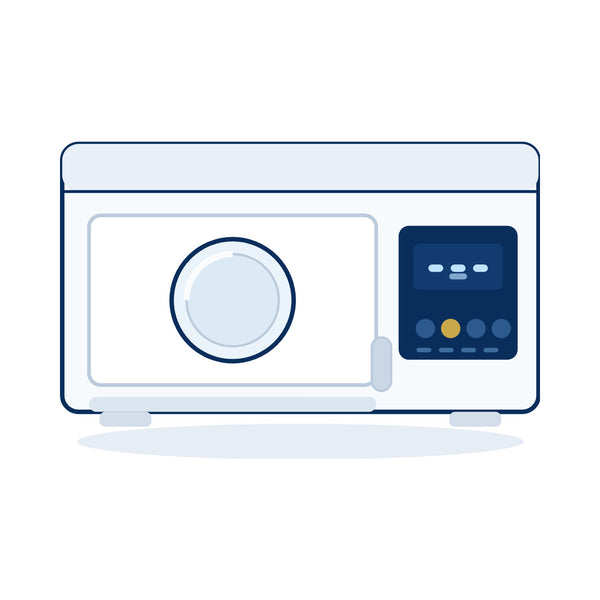

More about Equipment
Where a specification decides a purchase — voltage, well diameter, seal width, certification standard — it is quoted from the product listing itself, not from a distributor's summary, because those two drift apart quickly.
What does a Canadian clinic actually need on the equipment list?
Most of it falls into five groups, and only the first three are interdependent. A practice can open without magnification and without monitors; it cannot open without a way to clean, pack and verify instruments, because those three steps are what an infection-control inspection asks about.
| Equipment group | What the group does in the clinic | Where it is usually found |
|---|---|---|
| Cleaning | Lifts soil, cement residue and dried blood from instruments and cassettes before anything is packed | Any practice reprocessing reusable instruments: dental, veterinary, medical aesthetics |
| Packaging | Seals pouches and rolls to a measured seam so a pack stays sterile until the point of use | Same room as the cleaner, wherever packs are made rather than bought pre-sealed |
| Incubation and readout | Holds a biological indicator at 56–60 °C for its full readout and reports the result | Practices running a daily or per-load spore test and keeping the file |
| Magnification and light | Puts a magnified, lit field on a single tooth or site for fine work | Dental operatories, hygiene rooms, endodontic and surgical setups |
| Monitoring | Blood pressure, pulse oximetry, temperature and therapy devices used chairside or at home | Exam rooms, and in home-care and long-term-care settings |
The order of that table is the order of the spend. Clinics that buy the optics first and the reprocessing bench last usually end up running instruments through a tank that is too small for a cassette, which is a problem the machine cannot solve afterwards.
Which room does each piece belong in?
Sterilization room. Four units share one bench, and the job each one does is the reason the bench has a sequence. Cleaning comes first: the CS6.2 ultrasonic cleaner is a 6 L tank — the size at which a full instrument cassette fits in one cycle — with 32 kHz for heavier soil and 48 kHz for lumens and threaded joints. It cleans; it does not sterilise, and no ultrasonic unit does. Packing follows, and a constant-heat pouch sealer earns its bench space in exactly two cases: packs longer or wider than a stocked pouch, and rolls cut to the length actually needed. Verification is the third job, and it is one purchase or two: a 20-well dry-block incubator for 24-hour vials read by colour, or a 24-hour incubator with USB export where the temperature record has to leave the unit. A 4-well fluorescence reader only applies if the daily test is a rapid-readout indicator, and it ships as the instrument alone — the ampoules are a separate consumable, and one without the other reports nothing.
Exam and treatment room. Working distance is fixed per pair of loupes, so a clinician is measured before the order rather than fitted after it. The 2.5× flip-up pair, set to a working distance between 350 and 500 mm and adjustable for interpupillary distance, suits general dentistry and hygiene; the 3.5× prism pair shows a smaller field and belongs on endodontic and surgical work. Light is a separate decision rather than an accessory: the Core wireless headlight mounts on the same universal T-mount, adds roughly 12 g at the lamp head and charges over USB-C.
Home and bedside. Monitors are bought for a patient rather than for a room, and get replaced one at a time, so they are grouped on the health monitors page rather than here.
What has to be in place before a device can be used in a Canadian clinic?
Three things, and they are checked in this order by anyone who inspects the room.
Importer and licence. A device sold into Canada is imported by a company holding a Medical Device Establishment Licence, and the device itself sits under a licence or registration appropriate to its class. CliniEco Medical holds MDEL #35334, and licence numbers are stated on the listings that carry one. A supplier who cannot produce a licence number on request has ended the conversation rather than started it.
Electrical certification for a Canadian supply. Certification is issued against named standards, so the standard is what you ask for — not the word "certified". On this bench that means cETL by Intertek to CSA C22.2 No. 68 and UL 73 on the ultrasonic tank, and on the DLAB incubator cTUVus by TÜV Rheinland, certificate CU 72205506 0001, tested to UL 61010-1 and CAN/CSA-C22.2 No. 61010-1-12, with FCC Part 15 Subpart B and ICES-001 registrations on file. Voltage and frequency belong in the same check: 110 V / 60 Hz is the working assumption for a Canadian room, and a unit built for another supply needs a transformer before it needs bench space.
Reprocessing practice. Equipment supports a documented process; it does not create one. CSA Z314:23 is the current Canadian standard for reprocessing reusable medical devices in health care settings, and what an inspection looks for is the record behind each load — which cycle ran, which indicator was used, what it read, and who signed it off. A reader that stores results or an incubator that exports them helps you produce that file. Neither one writes it for you.
What should you ask a supplier before you commit?
Six questions, in this order. They are what separates a quotation from a purchase order.
- Which licence or registration covers this device, and what is the number?
- Which standards is the unit certified to, by which body, and what certificate number appears on the label?
- What is in the box at the quoted configuration — block, basket, lid, battery, spare — and what is priced separately?
- How is temperature or output verified, and does the unit keep or export a record, or does the record stay on paper?
- What consumable does the device depend on, is the format proprietary, and what is the reorder part number?
- Who services the unit in Canada, what is the warranty term, and how long does a replacement part take to arrive?
| Check | What to put in front of the supplier | What a usable answer looks like |
|---|---|---|
| Device licensing | Ask for the licence or registration number covering the device | A number in writing, matched to the model on the quotation |
| Electrical certification | Ask for the certification body and the standard numbers | Issuer plus standards plus certificate number, not a logo alone |
| Supply compatibility | Ask for the nameplate voltage and frequency | 110 V / 60 Hz stated, or the transformer requirement stated with it |
| Temperature control | Ask how accuracy is stated and how it is confirmed in the room | A tolerance figure plus the method used to verify it |
| Records | Ask whether the unit logs, prints or exports, and in what format | A plain answer either way; a unit with no export should say so |
| Arrival and service | Ask what is checked on delivery and who repairs it locally | A named Canadian service contact and a warranty term in months |
How do you receive and document equipment after it arrives?
Unpack in the room it will live in, not in a corridor, and do it while the delivery paperwork is still on the counter. Three things get recorded before the carton is broken down: the serial number as printed on the plate, the contents against the packing list, and any damage to the housing or the cord — photographed the same day, because a carrier claim made a week later is a harder conversation.
Then the asset register, one line per device: purchase date, serial number, warranty end, service agent, and where its documentation is filed. The maintenance record sits beside it, and on a reprocessing bench the maintenance record and the load record are in practice the same file — the week the sealer was serviced and the week a pack sealed badly tend to be the same week. Printable load and spore logs are kept in the compliance log centre, and they are worth printing before the first cycle rather than after the first inspection.
Where do multi-site and institutional orders go?
A five-chair clinic and a twelve-site long-term-care group do not buy equipment the same way. The second needs purchase orders, delivery windows, an asset list per site and one invoice instead of twelve. Institutional supply — clinics, dental groups, long-term care, schools and government buyers — is handled through the institutional supply enquiry, and a mixed order of equipment and consumables is quoted as one basket rather than line by line.
What this page deliberately leaves out
Steam sterilization itself. Which sterilizer to buy, how to load it, which cycle to run and how to validate a chamber are questions with their own answers, and they sit on the sterilization and ultrasonic equipment page — including the fact that the Class B benchtop unit we list is a pre-launch listing and not yet a purchasable model. This page is the way into the equipment range, not a substitute for that one.