
Medical Face Masks in Canada — ASTM Level 1, 2 & 3, by the Box or Case
Medical face masks sold in Canada are graded against ASTM F2100, a voluntary consensus standard that sorts masks into three barrier levels. This collection carries all three levels, packed as boxes of 50 and cases of 500, alongside an individually wrapped format and a 250-mask case. The level a mask is built to describes measured barrier performance, not the room it is worn in. The sections below set out what changes between levels, what is inside each pack, how a pack converts into a month of clinic use, and how Canadian and American requirements compare.



More about Medical Face Masks in Canada — ASTM Level 1, 2 & 3, by the Box or Case
Which masks are in this collection?
Five listings, all ear-loop masks with an adjustable nose strip, at three barrier levels:
- Aurelia face mask, ASTM Level 2, made in Canada — three-layer build with a melt-blown middle layer; 50 per box, 500 per case.
- Aurelia face mask, ASTM Level 3, made in Canada — the same three-layer build at the higher splash rating; 50 per box, 500 per case, in blue or pink rose.
- CliniEco 3-ply ASTM Level 3 mask — 250 masks in a five-box case, listed at bacterial and particle filtration of 98% or higher and 160 mmHg fluid resistance.
- CliniEco 3-ply ASTM Level 2 procedural mask — 50 per box, 500 per case, listed at 120 mmHg fluid resistance.
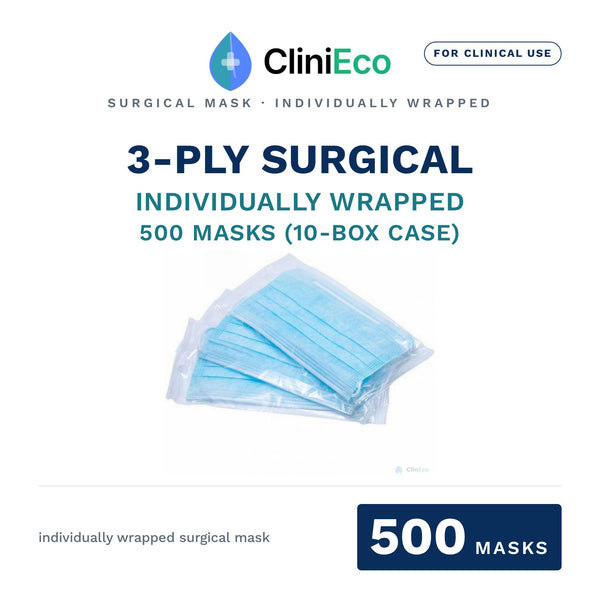
- CliniEco individually wrapped surgical mask — Level 2, each mask sealed in its own paper pouch; 50 per box, 500 per ten-box case.
What do the ASTM F2100 levels actually measure?
ASTM F2100 grades a mask on three measured properties: bacterial filtration efficiency, particle filtration efficiency at 0.1 µm, and resistance to synthetic blood, measured in millimetres of mercury using ASTM F1862. The current edition is ASTM F2100-25, which replaced F2100-23; the 2023 edition is now listed as historical, so a mask claim should name the edition it was tested to. Edition and level figures were checked on 2026-11-06.
| Level | Bacterial filtration | Particle filtration at 0.1 µm | Synthetic blood resistance | Where the level is normally specified |
|---|---|---|---|---|
| Level 1 | 95% or higher | 95% or higher | 80 mmHg | Reception areas and general examination where fluid is not expected |
| Level 2 | 98% or higher | 98% or higher | 120 mmHg | Routine procedures where a splash can reach the face |
| Level 3 | 98% or higher | 98% or higher | 160 mmHg | Surgical and hygiene appointments where more fluid is expected |
Two things follow from that table, and both are routinely missed in purchasing conversations. First, between Level 2 and Level 3 the filtration requirements are identical; the only requirement that rises is synthetic blood resistance, from 120 to 160 mmHg. A Level 3 mask is not a finer filter than a Level 2 mask. It is a mask that holds its barrier against a harder, higher-pressure splash. Second, the level thresholds only mean something when the edition is named, which is why a specification should quote F2100-25 today and not an edition that has been superseded.
Which level should a clinic or care home ask for?
The level is a test result rather than a legal minimum, so it is usually set by the procedure list and the office infection-control policy rather than by a statute. Three practical rules cover most rooms:
- Match the level to the wettest task in the room. A room that sees conversation and low-fluid examination can specify Level 1; a room where a splash can reach the face needs Level 2 at minimum.
- Go to Level 3 for the appointments with the most fluid. Hygiene appointments and surgical procedures are where the higher splash rating is normally specified, and that rating is the only property the extra level buys.
- Keep one level per room. Mixing levels within a room tends to produce masks pulled from the wrong box at the wrong moment; one level per room is easier to audit against an order history.
What is inside a box, and what is inside a case?
Every listing here is packed as boxes inside a case. The case holds the same mask as the box, so the box count is the only thing that changes when an order moves from box to case.
| Listing | Level | Build | Per box | Per case |
|---|---|---|---|---|
| Aurelia Level 2, made in Canada | Level 2 | Three layers, melt-blown middle layer | 50 | 500 (10 boxes) |
| Aurelia Level 3, made in Canada | Level 3 | Three layers, melt-blown middle layer | 50 | 500 (10 boxes) |
| CliniEco 3-ply Level 3 | Level 3 | Three-ply, melt-blown core | 50 | 250 (5 boxes, one case size) |
| CliniEco 3-ply Level 2 procedural | Level 2 | Three-ply: spunbond outer, melt-blown core, soft inner | 50 | 500 (10 boxes) |
| CliniEco individually wrapped | Level 2 | Three-ply, each mask in a sealed paper pouch | 50 | 500 (10 boxes) |
The CliniEco three-ply Level 3 case is the odd one out: it ships as a single 250-mask case of five boxes, with no separate box-level order code. For a room buying 500-mask cases, that is a smaller first commitment. For a room that wants one case size throughout, the Aurelia Level 3 case matches the 500-mask build.
How long does a 500-mask case last a two-chair room?
The arithmetic is simple once the appointment count is fixed. A two-chair room running 20 appointment blocks a day and using one mask per block goes through 20 masks on a working day. A 500-mask case therefore covers 25 working days, a little over a 21-day month, and a 250-mask case covers 12 or 13. Add the masks used for staff breaks, fitting and the spares kept at the front desk and the figure moves, which is why the assumption to write into a budget is masks per appointment rather than masks per month. That number survives a change of case size.
Which format suits a procedure room or a care home?
All five listings are ear-loop masks with an adjustable nose strip; there is no tie-on format in this collection. The difference that matters in practice is whether a mask is pulled from a dispenser box or opened from its own sealed pouch. Boxed masks suit a room where several masks are used in a shift and the box sits within reach. Individually wrapped masks suit a procedure tray, a spill kit, a first-aid station or a care-home cart, where a mask may sit unused for weeks and should be untouched when it is finally opened. The wrapped listing is also the one with a foam-padded nose clip.
How do Canadian and American requirements compare?
The mask is the same object on both sides of the border; the paperwork around it is not.
| Item | Canada | United States |
|---|---|---|
| Regulatory route | Medical device under the Medical Devices Regulations (SOR/98-282); the importer or distributor of record holds an establishment licence | Surgical apparel under 21 CFR 878.4040, Class II with special controls |
| Standing of ASTM F2100 | Voluntary consensus standard. No federal statutory minimum level, so the level is set by procurement documents and office infection-control policy | Voluntary as well, and recognised by the FDA in premarket review |
| Edition to quote | ASTM F2100-25, current; it replaced F2100-23, which is now listed as historical (checked 2026-11-06) | |
For a Canadian buyer the practical consequence is that the level on the box is a claim to be checked against a test report, not a licence condition. The Aurelia Level 2 and Level 3 listings cite Nelson Labs report PRB22172-SUP01 for their filtration figures, and the CliniEco listings state their own tested values on the page. Where an office protocol names a test method, ask for the report for the lot rather than relying on the level printed on the box.
Related reading
- Tie-on or ear loop masks: which retention suits the room — what changes when the mask is held by a knot rather than an elastic loop.
- Mask pleats and ear loop welds: what construction decides — the parts of a three-ply mask that sit outside the ASTM F2100 filtration figures.
- What a case of surgical masks costs in Canada in 2026, delivered — the landed-cost view of the same box and case counts described above.
Masks in this collection are supplied in Canada by CliniEco Medical under MDEL #35334. Single-site volumes can be sized on the clinic supply and cost planner, and multi-site or facility quantities are quoted through the institutional account enquiry page.