
Sterilization & Infection Control
A sterilization bench in a Canadian dental clinic runs on small consumables: one pouch per instrument set, one strip inside the tray, a line of tape across the fold, a spore test at the start of the day and a logbook entry at the end of it. This collection gathers what sits on that bench and in the room next to it - chemical and biological monitoring, sterilization packaging, the instruments that read the results, ultrasonic cleaning chemistry, and the specimen bags that leave the building. The sections below work through the questions that come up when a clinic, a long-term care home or a laboratory is sizing these lines for a year of cycles.
-
3 options$500.00
$558.48CAD
More about Sterilization & Infection Control
What does each monitoring layer actually tell you?
Four different questions get answered in a sterilization area, and no single indicator answers all of them. A Class 1 process indicator - the printed square on a roll, or a strip of autoclave tape - shows that a pack went through a cycle. It says nothing about steam reaching the centre of the load. A Class 4 indicator (ISO 11140-1 Type 4) responds to two or more variables and is designed for the specific process, which is why the dual-indicator strip on a Class 4 self-sealing pouch is the one an inspector reads when asking how you know a load was exposed properly.
A Class 5 integrator reads time, temperature and saturated steam together in one pass/fail window, and its accept result is designed to correspond to the lethality a biological indicator would show. A Class 2 Bowie-Dick test (ISO 11140-5) answers a different question again: whether a pre-vacuum chamber can remove air before steam enters, read at 134 C for 3.5 minutes on a sheet that simulates a 4 kg cotton pack. The biological indicator answers the only question that is about killing - did the spores survive. Each vial carries Geobacillus stearothermophilus ATCC 7953, the accepted steam challenge organism, at 1.0 x 10^6 spores or more, verified against ISO 11138-3.
| Layer | What it answers | How often it is used |
|---|---|---|
| Class 1 - tape, roll print | Did this pack go through a cycle? | Every pack |
| Class 4 - pouch indicator | Was the pack exposed to the process variables? | Every pack |
| Class 5 - integrator | Did the critical parameters arrive together inside the pack? | Every load, in trays and large packs |
| Class 2 - Bowie-Dick test | Can the chamber remove air? | First cycle of the day, pre-vacuum units only |
| Biological - spore test | Did the cycle kill the challenge organism? | Every day the sterilizer is used, in Ontario |
When is a Class 5 integrator enough, and when is a spore test required?
Both belong on the bench, and they are not interchangeable. A Class 5 integrator gives an immediate answer on every pack and is the layer that catches a cycle where the parameters did not arrive together. What it cannot do is detect a resistant organism surviving a cycle that looked correct on paper, because it is a chemical response, not a living one. The biological indicator is the direct evidence of lethality, and in Ontario the RCDSO requires a biological indicator for each sterilizer on every day that it is used - daily monitoring, not weekly.
A monitoring day uses two vials: one exposed test and one unexposed positive control. That is why a 50-pack covers about 25 monitoring days, and why the two-sterilizer practice needs the count doubled rather than shared. Records are a separate line item from vials. The RCDSO IPAC Standard of Practice (v3) expects the logbook to be kept for 10 years after the last entry, and the free sterilization log generator maps its fields to the RCDSO IPAC Self Audit Review Form (v2) so the page it prints can be checked line by line. The field list an auditor actually asks for is written out in Sterilization Log Requirements in Ontario.
How do you choose between 24-hour, 3-hour, 1-hour and 20-minute readouts?
Every tier in this collection carries the same strain under the same ISO reference, and every vial is activated after the cycle. What changes is how long the vial sits before the answer appears. The 24-hour self-contained vial reports by a visible colour change and needs no reader at all; it needs incubation at 56-60 C and nothing else. The three rapid tiers are fluorescence products: the vial contains an enzyme substrate, and after activation the result is read on an instrument. A fluorescence signal at the readout time is a positive result - the load failed and everything in it has to be re-sterilized. No signal means no enzyme activity was detected.
Speed is paid for on every single test, all year, not once on the box. Twenty minutes fits a single set that has to go back to the chair in the same session, one hour covers a morning list, and three hours closes out an ordinary clinic day. Buy the shortest readout your schedule genuinely needs, and run the rest of the week on the 24-hour vial.
| Readout | Where the result appears | Fits |
|---|---|---|
| 24 hours | Colour change in the vial, no instrument | Daily monitoring where the load is not needed the same day |
| 3 hours | Fluorescence reader, 56-60 C | A normal clinic day, closed out the same day |
| 1 hour | Fluorescence reader, 56-60 C | A morning list |
| 20 minutes | Fluorescence reader, 56-60 C | A set returning to the chair in the same session |
If you are weighing the two formats themselves rather than the speed, the definitions and vial formats are set out in What Is a Biological Indicator.
Pouches, rolls or tape - what should you stock?
Self-sealing pouches are the default for a fixed set of instrument sizes: Class 4 dual indicator, one face medical-grade paper at 60/70 GSM, the other a CPP/PET film, a self-seal strip and a peel-open tab, rated for steam at 121-135 C. Pick the size that fits your largest set, because a pouch that is too small will not seal flat across the fold. A 76 mm x 50 m heat-seal roll covers the jobs a pre-made pouch cannot: packs longer or wider than a stocked size, cut to length, with a Class 1 indicator printed on paper and film. At a 30 cm cut one roll yields roughly 166 packs.
Indicator tape does two jobs on many packs - sealing across the fold and carrying the date and cycle - which is why the honest planning figure is packs per roll rather than rolls per month. Count 10 cm across the fold plus 2 cm for the label and a pack takes about 12 cm, so a single 1 inch by 60 yard roll covers about eleven working days at 40 packs a day. A constant-heat pouch sealer earns its bench space only if you cut from a roll, where it produces a repeatable 12 mm peelable seam and the built-in cutter trims to length.
Who reads the result, and how long does the equipment hold the vials?
Two instruments solve two versions of the same problem. The four-well fluorescence reader holds ampoules at 56-60 C and reports a positive or negative result from the enzyme reaction; the instrument is bought once and the ampoules are the line you reorder every month. A dry-block incubator does the 24-hour job with no reader at all: vials sit at 56-60 C in a closed, lidded block for the full readout and are then read by eye against the control.
Count capacity against the vials you actually run in a batch, not against the number of packs. One monitoring day is one test plus one control per sterilizer, so a practice with two units needs four wells before the bench has done anything unusual.
Where does cleaning fit, before anything is pouched?
None of the monitoring above means much if bioburden is still on the instrument. The ultrasonic multi-enzyme concentrate is formulated low-foam so cavitation energy goes into the instrument surface instead of into a head of bubbles; four enzyme classes - protease, lipase, amylase and cellulase - plus biosurfactants break down blood, protein, fat and biofilm in a 2 to 10 minute cycle at 20-50 C. At the 1:400 dilution a 6 L tank needs 15 mL. Cleaning is the step that decides whether the indicators downstream are measuring a good cycle or a load that was never clean enough to sterilize.
Why does a specimen bag belong in a sterilization collection?
Because the sample leaves the room before anything is sterilized, and the two jobs are governed by different rules. The UN3373 specimen bags carry Category B biological substances; the packaging behind that classification is P650 on the road and IATA 650 in the air, and the 95 kPa figure is the internal pressure test in P650 (7)(e), held without leakage. The absorbent layer sits where P650 (7)(d) places it, and the document pouch keeps the requisition away from the sample. A three-wall 6 x 9 inch transport bag covers specimens that move by ground; it is not pressure-tested for air transport, so a sample that flies needs the 95 kPa bag instead.
The boundary is worth stating plainly, because it is where this collection is most often misread: a transport bag does not sterilize anything, and a sterilized instrument pouch is not transport packaging. No design-type approval is issued for either, and packing duty rests with the shipper.
Where should a clinic start with this list?
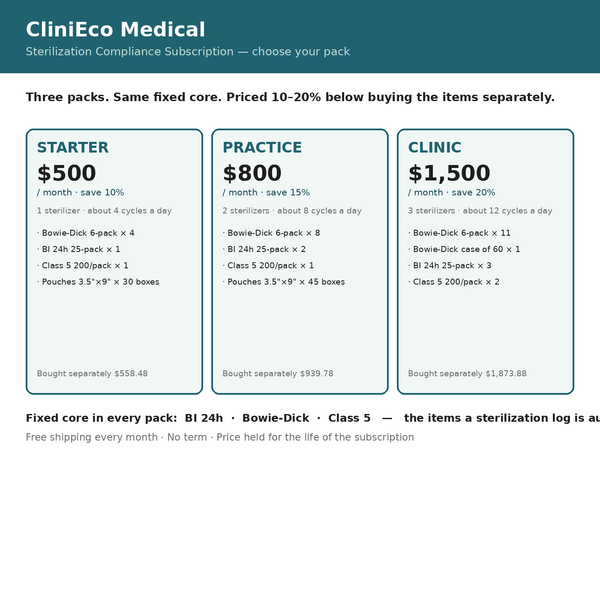
Count four things before ordering any of it: packs per day, monitoring days per month, sterilizers in the room, and whether a specimen ever flies. Those four numbers decide the pouch size, the pack count, the readout tier and the bag format, and everything else on this page follows from them. For a first order, a 24-hour 50-pack plus one pouch size plus a tape set covers a single-sterilizer chair-side workflow, and a 5-pack trial answers the spore-test question for a clinic that has never run one in house. A practice that would rather place one reorder than eight can start from the sterilization compliance assistant kit, which assembles the monitoring layers, the incubator and the record templates in one line - but check the air-removal component first, because the Bowie-Dick packs in it are for pre-vacuum cycles and a gravity unit would not use them.
For the wider map - which industries sterilize, and which library applies to each setting - see the sterilization compliance hub. For the requirements that apply in your province, run the free sterilization compliance self-check; it is set up for dental clinics first and needs no account. CliniEco Medical imports and distributes these lines in Canada under MDEL #35334, with English and French labelling and Toronto-based support.