
Incontinence Care
Incontinence care supplies for Canadian home care, long-term care and clinic use: briefs, pull-ons, underpads and washcloths, ordered by absorbency level and case count. Four absorbency levels let a care team match the product to the resident instead of guessing, and every listing states the absorbency rating and the exact count in the pack and the case. Everything ships from our Toronto warehouse; there are no minimums on a first order.
- Bulk Case (120 Pack)$298.80
$351.60CAD - Bulk Case (120 Pack)$202.80
$238.80CAD - Bulk Case (120 Pack)$238.80
$280.80CAD


-
Wound & Incontinence Care > Incontinence Care$39.99CAD
-
Wound & Incontinence Care > Incontinence Care$39.99CAD


More about Incontinence Care
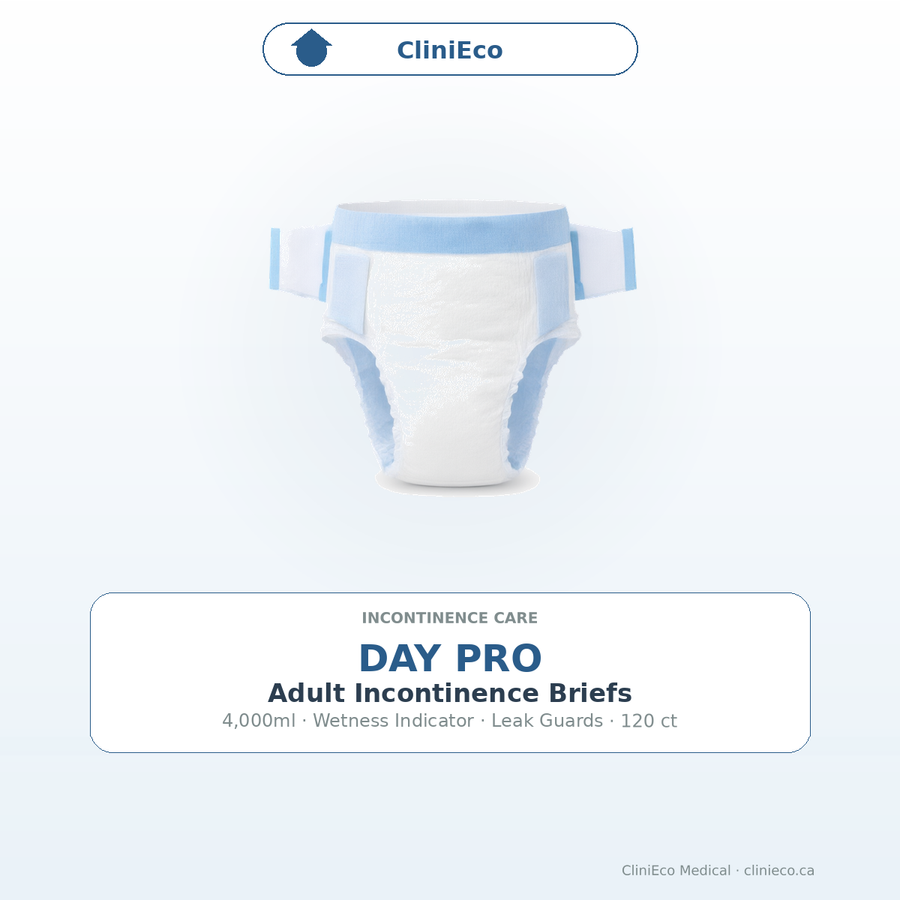
Most homes start with the daytime brief in the middle of the range and work outward from there — Day Pro adult briefs, 4,000 ml, 120 ct is the case most floors reorder, with the lighter and heavier lines added per resident rather than per floor.
What absorbency level fits which resident?
Absorbency is a specification, not a marketing word. Each level is a stated capacity in millilitres on the product, and the level a resident needs is set by how often the care plan changes them, whether they are mobile, and whether the void happens overnight. A resident changed every two hours does not need an overnight product; a resident on a 10–12 hour night interval does, whatever the daytime line says.
| Product line | Stated absorbency and format | Pack and case | Where it usually sits |
|---|---|---|---|
| Day Comfort brief | 3,000 ml, taped brief, light to moderate | 20-brief pack, 120-brief case | Daytime, mobile residents |
| Day Pro brief | 4,000 ml, taped brief, moderate to heavy | 20-brief pack, 120-brief case | Daytime default on a long-term care floor |
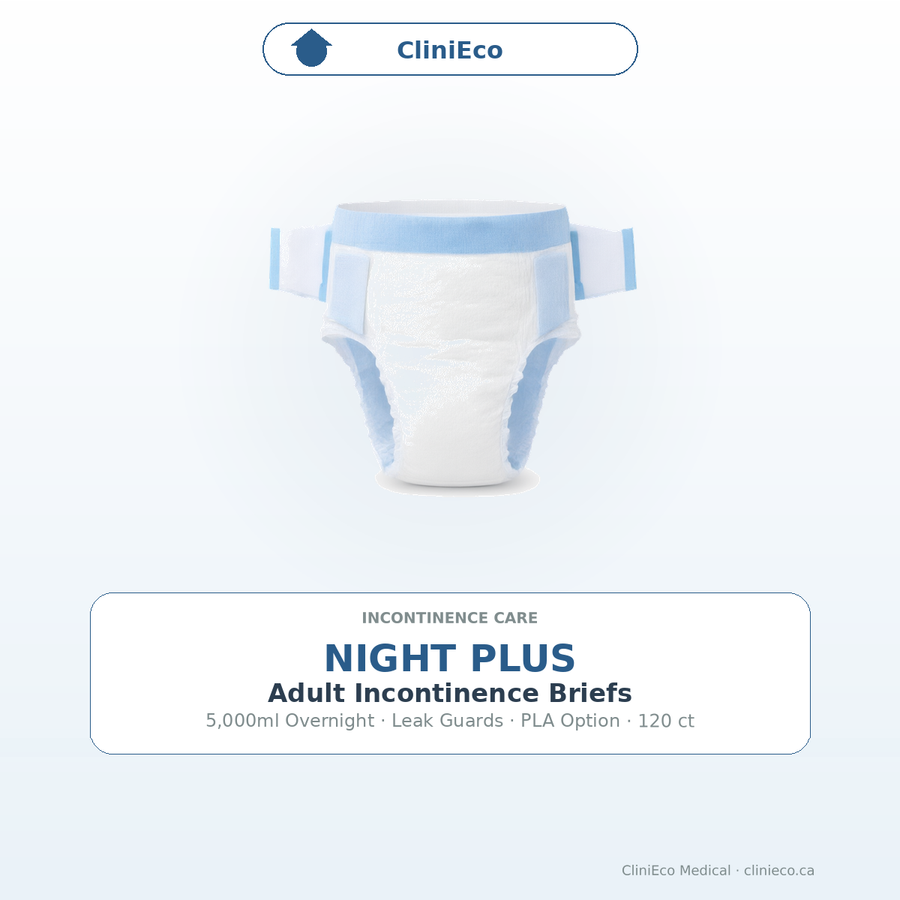
| Night Plus brief | 5,000 ml, taped brief, 10–12 hour overnight | 20-brief pack, 120-brief case | Night interval, heavier void |
| Pull-On maximum | Maximum absorbency, pull-on pant format | 120-brief bulk case | Ambulatory residents who dress themselves |
| Underpad, 60 × 90 cm | Five-layer, SAP core, vacuum compressed | 500 pads in a ten-box case | Bed protection under a brief |
| PLA underpad, 30 × 36 in | Heavy absorbency, biodegradable backsheet | 50-pad case | Homes with a waste-reduction policy |
| Disposable underpad, 30 × 36 in | Heavy absorbency, disposable | 4-pad pack | Trial, home care, single bedroom |
| Disposable washcloths | 10 × 13 in dry wipe | 500 per case | Peri-care, replaces cloth laundry |
Two cases set the edges of the range in most homes. The Day Comfort brief at 3,000 ml covers the mobile resident on a short change interval, and the Night Plus brief at 5,000 ml covers the 10 to 12 hour overnight interval. Everything else in the range sits between those two jobs.
Read the table as a menu, not a ladder. A floor usually stocks two brief levels and one underpad, because a single level forces either over-supply on light residents or a change interval that is too long on heavy ones. The mix is a clinical decision made by the care team; this page only sets out what each format is and how it ships.
How many briefs does a 40-bed home actually use?
Work from changes per resident per day, not from beds. At two briefs a day, forty residents draw eighty briefs a day, which is 560 a week. A 120-brief case covers 60 resident-days at that rate, so a 40-bed floor at two changes a day works through roughly five cases a week — and the arithmetic moves sharply if the care plan sets three or four changes.
For an overnight line the count is different again: one to two briefs per resident per night on a product rated for 10–12 hours. Forty residents at two briefs a night is about eighty briefs a night, roughly 560 a week, which is the same four to five cases unless the home splits night and day products across two case sizes. Homes that run separate day and night lines should hold a case of each rather than one mixed order.
| Setting | Changes per resident per day | What to stock | Order unit |
|---|---|---|---|
| Home care, single resident | Two to four | One brief level plus a 4-pack of pads | Pack and 4-pack, no case commitment |
| Retirement residence | Two to three | Day brief plus pull-on for ambulatory residents | Cases of 120 briefs |
| Long-term care floor, 30 to 40 beds | Two to four | Two brief levels, one underpad, washcloths | Four to seven cases a week |
| Complex continuing care | Four or more | Heavier brief plus underpads at every bed | Case quantities with a weekly par level |
| Clinic or walk-in setting | Sporadic | Underpads and washcloths only | Single case, replenished as used |
Read the table from the change rate, because that is the number the care plan sets. Two homes with the same bed count can run orders a factor of two apart if one changes every two hours and the other every four, and a par level copied from another home will be wrong in one direction or the other.
Brief, pull-on or underpad — which format when?
The three formats solve three different problems, and most homes need all three in some quantity. A taped brief is repositionable: it can be opened and refastened for a check without removing the product, which is why it is the default for a resident who is turned and positioned on a schedule. A pull-on is for a resident who stands and dresses with assistance or alone, and it behaves like underwear rather than like a garment that has to be laid out.
An underpad is not a substitute for either. It sits under the brief as bed protection, and it is what keeps a linen change from becoming a full bed change. A five-layer pad with a SAP core and a vacuum-compressed pack is the format a home buys by the case for storage density; a 30 × 36 in pad in a 4-pack is the format a family or a home-care programme buys to try before committing to a case.
What is the difference between a 4-pack and a case?
Volume and freight, not product. Four pads is a trial and a single-bedroom quantity: one resident on a turn-and-position protocol takes two to four pads a day, so a 4-pack is roughly two days of one bed. A floor works from the case, because a case is the unit that survives a freight rate, a storage room and a reorder cycle without a weekly purchase order.
The same split exists across the range. The 60 × 90 cm underpad ships as 500 pads in a ten-box case; the 30 × 36 in PLA underpad ships as a 50-pad case; the briefs ship as 120-brief cases with six packs of 20 inside. Knowing which unit the invoice uses is the difference between a stock room that rotates properly and one that runs out mid-week.
How should a home care agency order across several sites?
Consolidate the case counts, not the SKUs. An agency running four sites can hold one product per absorbency level and let each site order by the case, rather than letting each site invent its own line. The wholesale purchasing desk handles clinic and facility accounts, purchase orders and multi-site delivery, so a volume ordering desk can place one order that ships to several addresses.
Two practical rules. First, agree the unit before the price conversation: a case of 120 briefs and a case of 500 underpads are both "a case", and mixing them on one requisition is the most common ordering error in this category. Second, rotate on arrival — date each case and use the oldest first, because absorbency products compress and the packaging is the only thing holding the count honest.
Which supporting items belong in the same order?
Peri-care and catheter care travel with the absorbency order because they are consumed at the same moment. Disposable washcloths replace cloth wipes and remove a laundry load from the floor; the urology care kit covers pads and the essentials a catheter routine draws on; and the 60 × 90 cm underpads are the bed-protection case most homes standardise on.
For single-bedroom and family use, the disposable 30 × 36 in underpad in a 4-pack and the PLA biodegradable underpad case cover the same job at two different volumes, and the pull-on maximum brief covers the ambulatory resident who does not want a taped brief.
The category also has a planning side that costs nothing to use. The incontinence supply planner turns a resident count and a change rate into a printable quantity sheet, and the clinic supply and cost planner does the same across the whole consumable list. Both are print-and-take-away pages, which is how a purchasing office usually starts a par-level review.
How does stock holding change between home care and long-term care?
Home care buys in smaller units and stores in a closet; a long-term care home buys by the case and stores on a shelf that has to be counted. The same product can serve both, but the reorder trigger is different: a home-care programme reorders when the last pack is opened, while a home reorders when the shelf hits a par level that covers one week of changes plus a buffer.
Setting that par level is arithmetic, not judgement. Count the changes per day across the floor, multiply by seven, divide by the pack count, and add a buffer for admissions and isolation rooms. A 40-resident floor at three changes a day is 840 briefs a week, which is seven cases — a par level of eight gives one case of cover, and the order point is the number, not the sight of an empty shelf.
Related reading — Vacuum-compressed underpads in Canadian LTC, standing leak guards on adult briefs, and tape tabs and brief fixation on a night shift.
Frequently Asked Questions about incontinence care ordering
These are the questions a clinic ordering desk and a care home purchasing office ask most often when they move this category onto one order.
What does one case of adult briefs actually contain?
A case holds 120 briefs, packed as six packs of 20, and the listing sells the case rather than a single pack. That is the unit a care home reorders, so the useful arithmetic is resident-days: 120 briefs is 60 resident-days at two changes a day, and your own change rate gives the reorder interval from there.
How many underpads come in a case?
The 60 x 90 cm pad ships as 500 pads in a ten-box case, and the 30 x 36 in PLA biodegradable pad ships as a 50-pad case. A 30 x 36 in disposable pad is also sold as a 4-pack, which is the trial and single-bedroom size rather than a floor quantity.
Can one account order several absorbency levels together?
Yes. Absorbency level is a product choice, not an account tier, so a home can order a light daytime brief, a heavier night brief and an underpad on one purchase order and receive them in one delivery window. Splitting the order by change rate rather than by department keeps the par levels readable.
Do disposable washcloths replace cloth wipes on the floor?
They replace the cloth wipe and the laundry load that comes with it. A case holds 500 dry wipes in a 10 x 13 in size, used damp for peri-care, so the floor keeps a case on the cart and stops cycling face cloths through the laundry. The wipe is single use, which is the point of the swap.
How should a home care agency set a reorder point?
Count the changes per day, multiply by seven, divide by the pack count, then add a buffer for admissions and isolation rooms. A 40-bed floor at three changes a day draws 840 briefs a week, which is seven cases, so a par level of eight leaves one case of cover and the reorder trigger is that number.
Distribution: CliniEco Medical — MDEL #35334. Product descriptions here follow the live listing for each item; absorbency ratings are the manufacturer's stated capacity and are not a substitute for a care plan set by the clinical team.