
CliniEco · Loupes with Headlight channel
Six sets — loupes plus wireless headlight, assembled and tested before shipping.

Dental Loupes with Headlight
A loupes and headlight set is one carton: the magnification you chose, a wireless light already fitted to the same mount, and the batteries to carry that light through a clinical day. Six configurations sit in this collection — 2.5×, 3.0×, 3.5× and 4× Galilean sets, a 3.5× flip-up set with five working-distance settings, and a 3.5× angled set built around an upright working posture. Magnification and working distance are chosen when the order is placed, and nothing in the range needs a fitting appointment.
- 4 options$644.00
$773.00CAD - 5 options$959.00
$1,151.00CAD



-
4 options$2,049.00
$4,149.00CAD -
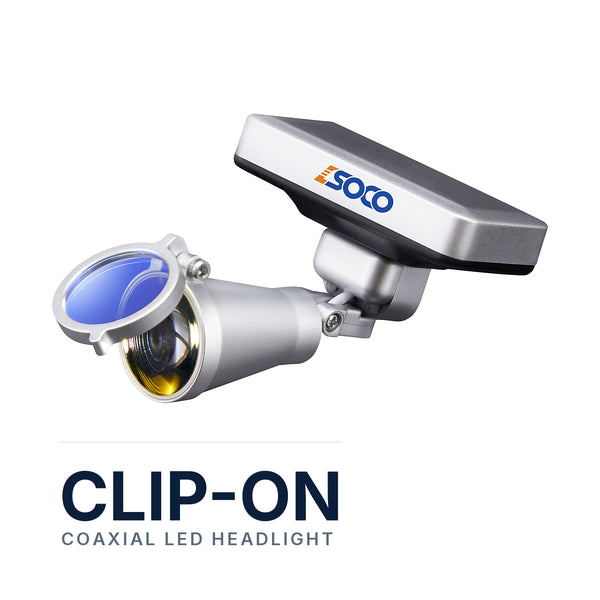
SCML05 · Clip-on LED Headlight$629.00CAD

More about Dental Loupes with Headlight
What ships in a loupes and headlight set?
Every set is packed to the same list, with the optics and the working-distance setting changing inside it.
- Flip-up or angled loupes on a clip mount that opens to 15 mm, with side shields, spare nose pads, a microfibre cloth and an instruction sheet.
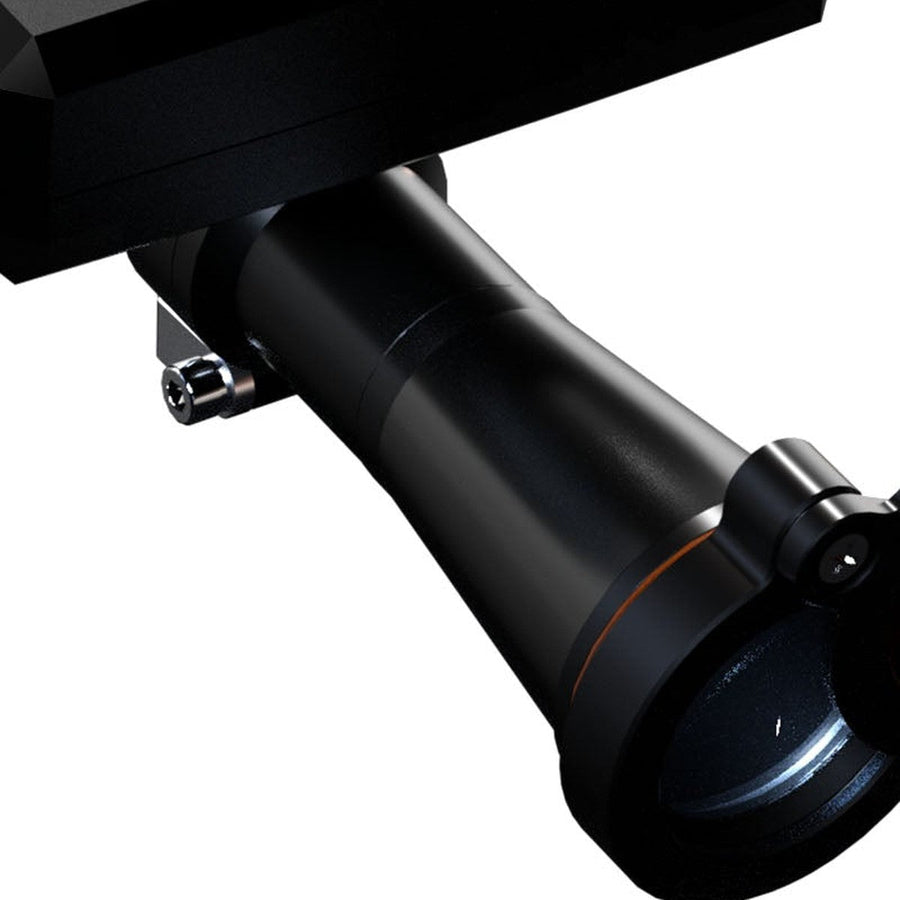
- The CliniEco Wireless Headlight in Core output: 32,000 lux at 40 cm, an 11.8 g lamp head, colour rendering index of 90 or above, and multi-step manual dimming.
- Three rechargeable USB-C batteries plus the charging cable, hot-swappable, about 8.4 hours of combined runtime, with an ETL certified charger.
- A headband for the clinician who would rather not clip the light to a frame bridge, and an orange filter that ships with the light.
The mount is the part worth reading twice. The clip grips a frame bridge of roughly 5 mm and opens to 15 mm, which is why the light fits the frames these sets already use and can move to a second pair later. A frame that holds a prescription insert in a different way needs its own bracket, and that is a question to settle before the order rather than after it.
Why buy a matched set rather than the light and the loupes separately?
Three things go wrong when the light arrives from one order and the optics from another. The mount does not line up, so the beam sits off the optical axis and the clinician tilts the head to compensate. The colour temperature does not match, so tissue and margin tones shift when the light is switched on. And the two items carry two service routes, which means a repair question has to be asked twice.
A matched set removes all three by construction: the light is fitted to the same mount, the same list applies to both parts, and one carton arrives on one day. That last point matters more than it sounds when a locum starts on a Monday and the optics and the light have to be in the same operatory at the same time.
How much light do you actually need?
Lux figures are only comparable at the same distance, and a number quoted without a distance means very little. The set uses a 400 mm reference because that is the working distance most restorative and hygiene work happens at. At that distance, 32,000 lux puts a bright, neutral field on the site without washing out surface detail, and the colour rendering index of 90 or above keeps tissue tones distinguishable rather than flat.
Weight matters as much as output on a frame worn all day. The Core lamp head is 11.8 g, which does not change the balance of a 70 g loupe set; a heavier unit on the same mount does, and clinicians notice it in the neck before they notice the extra brightness. A higher-output Pro headlight exists in the range, with dual hot-swap batteries, and its final output figure is being confirmed on the first production run — it is not listed for sale yet, so every set in this collection ships with Core.
| Headlight | Output | Lamp head | Batteries |
|---|---|---|---|
| Core — in every set here | 32,000 lux at 40 cm, multi-step manual dimming | approx. 11.8 g, colour rendering index 90 or above | 3 × USB-C, hot-swappable, approx. 8.4 h combined |
| Pro — not yet listed | Higher than Core, final figure confirmed on the first production run | Same mount, dual hot-swap batteries | 2 × hot-swap packs, charged over USB-C |
Which magnification goes with which working distance?
The order of the two decisions is not interchangeable. Working distance comes first, because it is fixed per pair when the order is placed and cannot be changed afterwards; magnification is then chosen against the field that distance gives you. Measure from your eyes to the work surface in the posture you actually work in, and if the number falls inside two groups, take the group with room on both sides.
| Magnification | Working-distance groups | Field at 400 mm | Where it tends to land |
|---|---|---|---|
| 2.5× | S 280–380 · R 360–460 · L 440–540 · XL 500–600 mm | ≈90 mm | Hygiene, examinations, quadrant work |
| 3.0× | Same four groups | ≈75 mm (approximate) | Mixed caseload, frames shared between clinicians |
| 3.5× | Same four groups; the flip-up 3.5× set offers 340 / 420 / 460 / 500 / 550 mm | ≈65 mm | Margins, endodontic access, fine restorative |
| 4× | Same four groups | ≈56 mm (approximate) | Detailed restorative, the last step before prism optics |
The 3.5× figure is the one quoted on the individual product pages; the 3.0× and 4× fields are approximate, scaled from the same optics at the same distance, and are marked that way rather than presented as measured. Field width grows as the working distance lengthens and shrinks as it shortens, which is why the same magnification feels different in a short-seating pair and a long-reach pair.
What changes at the chair — deep field, long sessions and shared operatories
In posterior, endodontic and surgical sites the operatory light is often behind the clinician or blocked by a hand, and the site sits in shadow exactly when the work is most detailed. A head-mounted light puts the illumination on the axis the eyes are already using, so the shadow moves with the head instead of forcing a reposition of the overhead. That is the case the light is built for, and it is why the set is worth considering at the point a caseload starts including those sites.
Long sessions change the balance of the decision. The angled 3.5× set puts the optical path at roughly 45° to the line of sight, so the head stays closer to upright while the light tracks the site below the eyepiece; the same light on a straight flip-up frame is a lighter combination, at the cost of more cervical flexion across a full day. Neither is wrong — they answer different complaints.
Shared operatories are the third case. Flip-up optics swing out of the line of sight when the clinician works unaided, and interpupillary distance and declination adjust on the frame, so one set can pass between two clinicians in the same room. The headlight adds a cleaning step between users and a battery rotation, which is a small protocol rather than a problem: three cells mean one can be on charge while two are in use.
Does the headlight fit a frame you already own?
The clip opens to 15 mm and grips a bridge of roughly 5 mm, and a headband is included for frames that do not take a clip comfortably. The two frames this light is built around are the 2.5× and 3.5× flip-up designs, both of which carry the matching mount point. A frame that holds a prescription insert in a different way will need its own bracket — send us the frame model before ordering and we will tell you which route applies rather than leave you to discover it on arrival.
What to confirm before ordering and check on arrival
Three things before the order: the working distance, measured in the working posture and taken as the median of three readings rather than a single guess; the pupil distance, which stays adjustable on the frame and so does not need a fitting visit; and any prescription eyewear in the practice, because an insert changes how the light mounts. Magnification is the last decision, made against the field the chosen distance gives you.
On arrival, run the light through one full charge cycle and rotate the three cells so you know the runtime on your own caseload. Check the clip tension on the frame you will actually wear, confirm the site is in focus at the distance you measured rather than at the distance you assumed, and register which cell is which if the set will be shared. Orders are processed in one to two business days from Toronto, reaching Ontario in 24 to 48 hours and the rest of Canada in three to seven business days.
Next step
If magnification is still open, the dental loupes buying guide for Canadian clinics compares field of view at every working distance. For the optical designs behind the sets, the Galilean loupes collection covers the wide-field range at 2.5× to 4×, the prism loupes collection covers 5× and above, and the angled loupes collection covers the upright-posture pair. Individual sets are listed as the 2.5× loupes and headlight set, the 3.0× set, the 3.5× set, the 4× set, the 3.5× flip-up set with five working-distance settings and the 3.5× angled set. The light on its own is listed as the CliniEco Wireless Headlight, and clinics buying for several operatories can start from the clinic and institutional account route.
CliniEco Medical is a Health Canada licensed importer and distributor — MDEL #35334 — shipping from Toronto.