
Aurelia Gloves Canada (Supermax)
Aurelia by Supermax clinic consumables distributed in Canada, in the pack sizes a treatment room actually works through. This collection covers the mask, hand-hygiene, surface-wipe and patient-bib formats CliniEco Medical lists for Canadian clinics, care homes and dental operatories. Glove lines from the same manufacturer are catalogued separately. For each format below the table gives the standard the product is tested to, the pack it is supplied in, and how many units sit behind the chair once a case is opened.


More about Aurelia Gloves Canada (Supermax)
Which Aurelia (Supermax) products are in this collection, and what pack does each one come in?
Six listings cover four categories: two medical face masks, two antiseptic hand rubs, one surface disinfecting wipe and one patient bib. Each one is a line CliniEco Medical distributes in Canada, which matters at reorder time because the pack format you standardise on is the format the whole ordering cycle is built around. The masks are made in Canada; the hand rubs carry a single Natural Product Number across both pack sizes, which is what lets a clinic treat the pocket bottle and the twelve-bottle clinic pack as the same product on a purchase order.
| Listing | Category | Format on the label | Pack format |
|---|---|---|---|
| Aurelia face mask, ASTM Level 2 | Face protection | ASTM F2100 Level 2, three layers with a melt-blown middle layer, ear loops, adjustable nose bridge, blue | 50 per box; case of 10 boxes (500) |
| Aurelia face mask, ASTM Level 3 | Face protection | ASTM F2100 Level 3, three layers with a melt-blown middle layer, ear loops, adjustable nose bridge, blue or pink rose | 50 per box; case of 10 boxes (500) |
| DermaSeptyl 2-in-1 antiseptic hand rub, 60 ml | Hand hygiene | NPN 80122015; 70% ethyl alcohol by volume; shea butter and natural oils | 10 bottles of 60 ml |
| DermaSeptyl 2-in-1 antiseptic hand rub, clinic pack | Hand hygiene | Same formulation, NPN 80122015; 60 ml bottle | 12 bottles of 60 ml |
| Aurelia disinfecting wipes | Surface disinfection | DIN 02519275; 100 per cent biodegradable cotton wipe | 160 wipes per pack |
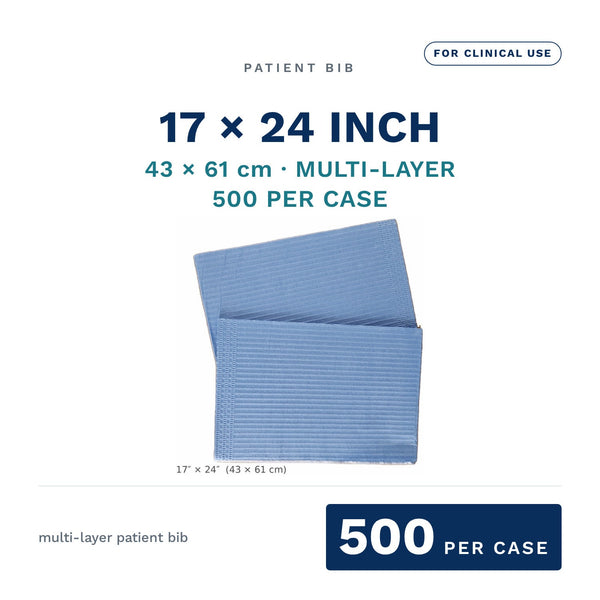
| Aurelia patient bibs | Exam room consumable | 17 by 24 inches, multi-layer, non-sterile, single use, ten colours | 500 per case, in four inner packs of 125 |
ASTM F2100 Level 2 or Level 3: what actually changes between them?
This is the question that decides most mask spend, and the answer is narrower than the habit of buying up suggests. Between Level 2 and Level 3 the bacterial filtration efficiency requirement is identical at 98% or above, the sub-micron particulate filtration requirement is identical at 98% or above, and the differential pressure ceiling is identical at below 6.0 mm H2O per square centimetre. Exactly one requirement moves: resistance to penetration by synthetic blood, from 120 mm Hg at Level 2 to 160 mm Hg at Level 3. So Level 3 is not a finer filter than Level 2. It is the same filter inside a barrier tested against a harder, higher-velocity splash.
That distinction matters because clinics tend to buy level by habit. If the procedure produces spray under pressure, at close range, or in a field where a pulsating jet can reach the face, the fluid-resistance column is the one to buy. If the procedure produces droplets and slow splashes, Level 2 covers it, and the extra money buys a property the room does not stress. Level 1 is a different conversation, because there both filtration and pressure drop move as well.
| Requirement | Level 1 | Level 2 | Level 3 |
|---|---|---|---|
| Bacterial filtration efficiency (ASTM F2101) | at least 95% | at least 98% | at least 98% |
| Sub-micron particulate filtration at 0.1 micrometre | at least 95% | at least 98% | at least 98% |
| Resistance to synthetic blood (ASTM F1862) | 80 mm Hg | 120 mm Hg | 160 mm Hg |
| Differential pressure (breathability) | below 5.0 mm H2O/cm2 | below 6.0 mm H2O/cm2 | below 6.0 mm H2O/cm2 |
| Flame spread | Class 1 | Class 1 | Class 1 |
The edition you cite is part of the specification. ASTM F2100 is currently published as F2100-25, and the earlier F2100-23 is now listed by ASTM as historical. A test report written against a superseded edition is not wrong, but a procurement file should record which edition the declaration refers to, because the level thresholds are only meaningful once the edition is named.
How does Canada regulate these four product categories compared with the United States?
The same box of masks, the same bottle of hand rub and the same pack of wipes cross two different regulatory systems, and the identifier printed on the label is the fastest way to see it. In Canada an antiseptic hand rub is authorised as a natural health product and carries a Natural Product Number, while in the United States the same product is an over-the-counter drug with a Drug Facts panel. A hard-surface disinfecting wipe inverts the logic: in Canada it is a drug with a Drug Identification Number, while in the United States it is a registered pesticide with an EPA registration number, outside the drug framework entirely.
| Item | Canada | United States |
|---|---|---|
| Medical face mask | Device under the Medical Devices Regulations; the distributor holds a Medical Device Establishment Licence (CliniEco Medical: MDEL #35334). ASTM F2100 is a voluntary specification a buyer writes into the purchase order, not a level set by statute. | Device under 21 CFR 878.4040, surgical apparel |
| Antiseptic hand rub | Natural health product; Natural Product Number on the label (NPN 80122015 on both DermaSeptyl packs) | Over-the-counter drug; Drug Facts panel under the FDA OTC monograph system |
| Surface disinfecting wipe | Drug; Drug Identification Number (DIN 02519275 on this wipe) | Registered pesticide under FIFRA; EPA registration number |
| Who is licensed | The establishment that distributes devices needs an MDEL; the product itself is not registered per unit | Establishment registration plus device listing with the FDA |
| Label language | English and French | English |
Does the same mask have to be labelled differently in Canada and the United States?
Yes, and the difference is more than translation. A medical device sold in Canada carries labelling in both English and French, so the carton and the instructions have a bilingual requirement that the same product sold in the United States does not. The identifiers differ too: the Canadian carton points to a distributor operating under a Medical Device Establishment Licence, while the American carton sits inside the FDA device framework with establishment registration and device listing behind it. A buyer comparing two quotes for what looks like the same mask should compare the label language and the authorisation route, not only the level marking, because the two cartons are not interchangeable stock even when the product inside is equivalent.
What does an NPN mean on a hand rub, and why do the wipes carry a DIN instead?
Both numbers are Health Canada identifiers, and the difference is the framework behind them. A Natural Product Number is issued under the Natural Health Products Regulations and belongs to a product authorised as a natural health product; a Drug Identification Number is issued under the Food and Drug Regulations and belongs to a drug. Antiseptic products applied to skin sit on the natural health product side, which is why the hand rubs carry NPN 80122015. A product that disinfects a hard surface is making a different claim, and that claim puts it on the drug side, which is why the wipes carry DIN 02519275.
The practical consequence for a clinic is the scope of what the label may assert and what the safety data sheet has to agree with. Record the exact string, including any zero at the front of the number, because that string is what has to match the supplier paperwork and the infection-control binder. Two bottles at the same alcohol strength can still be different products under different numbers, so strength alone is not an identity.
How do masks, hand rub, wipes and bibs sequence through one operatory turnover?
The consumables in this collection are not interchangeable, and the order they are used in matters more than the quantity kept on the shelf. The bib goes on before the patient is seated, in the format that covers chest and lap together when a wet field is expected. The mask is donned before the procedure starts and removed after it ends, not pulled down between steps. The hand rub sits at the point of care and is used at entry and at exit, and the bottle position matters more than the bottle size, because a rub that is out of reach does not get used. The wipe closes the room: touch surfaces that the next patient will contact, applied with the wet contact time printed on that product's own label, which is product-specific and cannot be carried over from a different wipe.
Written down, that is four consumables and four decision points. Written down badly, it becomes a single line about keeping the room stocked, which is how clinics end up with a full shelf and an empty point-of-care station.
Which pack size should a clinic standardise on: box, ten-pack, clinic pack or case?
Order in the unit you receive, count in the unit you use. Masks arrive as a box of 50 and a case of ten boxes, so the box is the operatory bin and the case is the stockroom unit. The hand rub comes as ten bottles or as twelve, and the number to design around is the number of dispensing points, not the number of clinicians, because a bottle lives at a sink or a doorway. Bibs arrive as 500 with four inner packs of 125, so the inner pack is the working unit and the case is the quarter's supply for one chair. Wipes arrive at 160 per pack, which is a room-level unit rather than a building-level one.
Par levels follow from that arithmetic: two weeks of use at the slowest station is a safer trigger than an average across the building, because the station that runs dry first is the one that stops the schedule. A pack size that is too large for a station turns into a storage problem, and a pack size that is too small turns into an ordering problem.
What should a buyer check on the lot when the delivery arrives?
Four fields, every time: the registration number printed on the unit against the number on the purchase order, the level marking on the mask box against the level written into the procedure, the pack count against the pack count ordered, and the expiry or shelf-life statement on the case against the storage plan. None of these take more than a minute, and each one is the thing a recall notice or an inspection will ask about first. Keep the lot number from the shipping label in the same file, because a product code alone will not identify a bad batch.
Standards and sources behind this page
The documents below are the ones a buyer can hand to a supplier or an inspector. Editions and links were checked on 6 November 2026. The level thresholds in this page are taken from the current edition of the mask specification, ASTM F2100-25; the earlier F2100-23 is now listed by ASTM as historical. ASTM F2100-25, Standard Specification for Performance of Materials Used in Medical Face Masks. ASTM F2101-25, bacterial filtration efficiency of medical face mask materials. ASTM F1862 is the synthetic blood penetration test method referenced inside ASTM F2100 and is not reproduced here. 21 CFR 878.4040, surgical apparel. Health Canada, natural and non-prescription health products. Health Canada, medical devices. CDC, hand hygiene in healthcare settings.
Related reading
Background on the two-number question and on mask construction: DIN or NPN: which number applies to a clinic surface disinfectant in Canada, tie-on or ear-loop masks and what ASTM F2100 leaves out, and mask pleats and ear-loop welds.
Frequently asked questions
Is ASTM F2100 a Canadian legal requirement?
No. ASTM F2100 is a voluntary specification, and no Canadian statute sets a minimum mask level. What makes it binding in practice is the purchase order and the procedure document that name the level, which is why the edition and the level belong in the specification rather than in a general claim about protection.
Are the two DermaSeptyl packs the same product?
Yes. Both the ten-bottle pack and the twelve-bottle clinic pack carry NPN 80122015 and the same 60 ml bottle, so the difference between them is pack count and the number of dispensing points covered, not formulation.
Do the masks and the wipes share a registration route?
No. The masks are devices, the hand rubs are natural health products with an NPN, and the wipes are drugs with a DIN. Three routes, three identifiers, and a clinic file should hold each one under its own heading.
How many bibs does a case put behind one chair?
A case holds 500 bibs in four inner packs of 125, so one chair changing a bib for every patient works through an inner pack and then the next, rather than opening the case at once.
Where does an institutional buyer start?
With the specification sheet for the exact codes in use, then the pack-count arithmetic for each station. Volume requirements, mixed cases and multi-site accounts are handled through the institutional account enquiry page; the clinic supply planner and the compliance log centre carry the record-keeping side, and non-sterile supply questions can also go to the compliance consultation desk.
Distribution: CliniEco Medical — MDEL #35334. Formats and pack counts in this collection are those printed on the current product listings; confirm the registration number on the unit you receive against the number on your purchase order.