
Class 5 Chemical Integrators — ISO 11140-1 Type 5
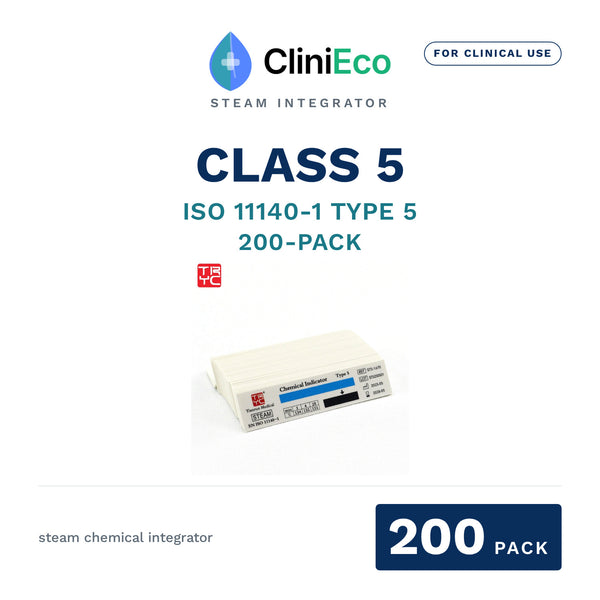
Class 5 chemical integrators are the strips Canadian clinics tape inside every sterilization pack to prove that steam actually reached the load — not just that the autoclave ran. This collection holds the ISO 11140-1 Type 5 integrator we stock, in a 200-strip pack for clinics that test one autoclave and in a 1,000-strip case for clinics running several loads a day. Both are the same Type 5 strip; only the pack size changes.
More about Class 5 Chemical Integrators — ISO 11140-1 Type 5
What a Class 5 integrator actually is (ISO 11140-1 Type 5)
A Class 5 integrator is a chemical indicator whose coloured front moves across a printed scale in response to the combination of time, temperature, and saturated steam — the three critical parameters of a steam cycle. It is designed to react at a defined window (for example 134 °C / 4 minutes or 121 °C / 15 minutes, depending on the strip) and to give a pass result only when the whole window has been met.
That makes it different from the tape on the outside of the pouch. Tape tells you a package was processed. A Class 5 strip tells you the conditions inside the pack were met, which is why accreditation and IPAC-style audits ask for one to be placed inside each pack, alongside the external indicator.
Class 5 vs Class 1 vs Class 2 vs Class 6 — which one goes where
The classes are defined by what the indicator is able to detect, not by price or brand:
- Class 1 — external process indicator (autoclave tape, indicator labels). It distinguishes processed from unprocessed packs. It goes on the outside.
- Class 2 — a specific test indicator, in practice the Bowie-Dick test pack used to check air removal in pre-vacuum cycles.
- Class 5 — integrating indicator. It responds to all critical parameters and is placed inside the pack, next to the instruments.
- Class 6 — emulating indicator, built to the same response window as a biological indicator for a given cycle.
Class 5 is not a replacement for biological indicators. A Class 5 strip is chemical; a biological indicator contains spores. Most Canadian clinics run both: an integrator in every pack, and a spore test on the schedule their provincial guidance or accreditation body sets.
How much does a Class 5 integrator cost per strip in Canada?
Cost per strip is the only number that matters for a consumable you place in every pack. The two pack sizes we stock work out like this at the prices listed on this page:
| Pack size | Price | Cost per strip | Typical use |
|---|---|---|---|
| 200 strips | $17.99 | $0.090 | 1–2 autoclaves, low daily load |
| 1,000 strips (5 × 200) | $79.00 | $0.079 | 3+ autoclaves or high daily load |
Moving from the 200-strip pack to the 1,000-strip case saves about $0.011 per strip, which is roughly 12%. On 1,500 strips a year that is around $17 — real money, but not enough to justify holding a large case if you are not certain of the expiry date or if you only run one autoclave. Buy the pack size that matches your load count and your storage.
How many Class 5 integrators does a clinic use in a year?
The arithmetic is simple, and it is worth doing once so you can size your order and your storage:
Loads per day × working days per year = strips per year (one strip per pack).
For example, a three-operatory practice running 6 loads a day, 250 days a year, uses about 1,500 packs — so about 1,500 strips, or one and a half cases of 1,000. A single-chair clinic running 3 loads a day over the same year uses about 750 strips, which is four 200-strip packs. Neither number includes the strips you will consume re-testing after a failed cycle, so keep a small buffer.
How to read and record an integrator after a cycle
Read the strip after the pack has cooled and dried, not while it is still hot from the chamber. Compare the leading edge of the colour change against the accept line printed on the strip: a pass means the front has moved past the line and the colour has reached the reference block. A strip that has moved only partway, or that shows an uneven front, is a failed pack — do not release the load until it has been re-processed and re-tested.
Record the result for every load: date, autoclave ID, cycle number, integrator lot, and pass/fail. That record is what an auditor asks for. If you do not already have a sheet for it, our printable sterilization and compliance logs are free and print on a single page — no login required.
Where to order ISO 11140-1 Type 5 integrators in Canada
We stock the Type 5 integrator described above in both pack sizes and ship from Toronto, so Ontario clinics usually receive it in one to three business days and the rest of Canada within a week. CliniEco holds MDEL #35334, and the invoice is issued in CAD with the lot number and expiry printed on the box.
Order the CliniEco Class 5 steam chemical integrator in the 200-strip pack or the 1,000-strip case. If you are sizing a first order for a new autoclave, use the loads-per-day arithmetic above and buy one pack size up — repacking mid-year costs more in shipping than the case saves.