
For Tattoo Studios
A single-chair tattoo studio runs on four consumable groups between clients: single-use sharps that arrive in unopened packaging, barriers and covers for anything that cannot be reprocessed, a Health Canada-registered disinfectant for surfaces, and hand hygiene supplies at the station. The rest of the setup is process, and Ontario's personal service settings regulation sets out what the process has to include.
-
Sterilization & Infection Control > Steril...$497.00
$597.00CAD


More about For Tattoo Studios
Single-use supplies and sterilization consumables for tattoo studios — gloves, needles-safe sharps disposal, autoclave pouches, indicators and surface barriers, shipped from our Toronto warehouse.
What do tattoo studios need for a sterile setup between clients?
The requirement is set by the province, not by the supplier, and in Ontario it is O. Reg. 136/18 under the Health Protection and Promotion Act, which applies to personal service settings that provide invasive procedures. The regulation defines an invasive procedure as one that introduces equipment or instruments into the body by cutting, puncturing or otherwise entering intact skin or mucous membranes, which is why tattooing falls inside it and why the equipment rules are written in the language of single use rather than of cleaning.
Section 10(6) requires that sharps used for invasive procedures be for a single use and come from packaging that has not been previously opened, damaged or compromised. Section 10(5) requires that any instrument designed for a single use, or made of a material that does not withstand cleaning and disinfection, be discarded immediately after use. Section 10(4) covers everything else: reusable equipment is cleaned and disinfected or sterilized between each use, or covered with a single-use disposable cover that is discarded after each use where the item cannot be reprocessed and is not introduced into the body.
Surfaces and hands sit under separate sections. Section 11(2) requires that disinfectants carry a drug identification number or natural product number assigned by Health Canada and be used according to the manufacturer's instructions, with chlorine bleach as the one exception to the numbering rule. Section 12(2) requires the person providing the service to clean their hands as often as necessary to prevent disease transmission and at least before and after providing a personal service. Section 8(3) adds the plumbing requirement: where reusable equipment is used, the setting needs at least one sink that is not the hand wash sink, able to immerse the largest piece of equipment, supplied with potable hot and cold running water under pressure, with counter space for preparing equipment, outside any room containing a toilet.
Which glove, mask and wipe sizes / formats fit a single-chair studio?
A single chair changes the order of magnitude rather than the list. Gloves are the item that scales most directly with client volume, and a nitrile examination glove in the 3.5 mil range is the usual choice where the glove is changed between clients and between clean and contaminated steps. Size splitting matters more in a small studio than in a large one, because two artists rarely share a size and a case ordered in one size leaves the other artist short.
Masks are a per-client item in a studio where the artist works within arm's length of the client for an hour or more, and a three-ply mask with an ASTM barrier level stated on the box is the format that can be referenced in the studio's written procedure. Wipes and washcloths are the consumable that quietly disappears fastest, because they are used between clients on chairs, armrests, trays and lamps as well as on skin.
| Item | Format that fits a single-chair studio | What it is used for |
|---|---|---|
| Nitrile examination gloves | 3.5 mil, blue, 1,000 per case, sizes S to XL | Per client, and again between clean and contaminated steps |
| Face masks | 3-ply, ASTM barrier level stated, 250 masks per pack | Artist and client, per appointment |
| Dry wipes and washcloths | 10 by 13 inch, 500 per case | Surface wiping, tray wipe-down, general cleanup between clients |
| Surface disinfectant | Health Canada registered, DIN or NPN on the label | Work surfaces, trays, lamps and chairs between clients |
| Sharps containers | 1 quart, puncture resistant, fill line marked | Needles and blades, at the point of use |
How do I keep cross-contamination under control without buying extra equipment?
Most of the control comes from three habits that cost consumables rather than capital. The first is treating the station as a zone: clean supplies stay on one side and used items go directly into a container at the point of use, which is what section 10(7) describes when it requires sharps to be disposed of immediately after use in a container located in close proximity to where the service is provided. The second is covering instead of cleaning where a surface cannot be reprocessed, since a disposable cover discarded after each use satisfies section 10(4)(b) without a second machine. The third is buying pre-packaged rather than decanting, because section 11(1) requires products to be stored and dispensed in a manner that prevents contamination, and a refilled bottle cannot show that it was.
Storage discipline carries the same weight as technique in a small room. A studio that keeps clean supplies in a closed drawer and used items on the tray has already separated the two paths; a studio that keeps both on the same trolley has created a handling question that no amount of additional equipment resolves. Section 10(3) also requires the manufacturer's instructions for equipment to be kept at the setting where the person providing the service can reach them, which is the document an inspector will ask for before asking anything about technique.
What should a first order look like (quantity per station / per week)?
The figures below assume one chair, four to five clients a day and five working days, with gloves changed once per client and a second time at the clean-up step. They are arithmetic on that assumption, not a regulatory requirement, and a studio doing longer sessions or colour work should scale the glove and wipe lines rather than the paper lines.
| Consumable | First order | How long it lasts at 4 to 5 clients a day |
|---|---|---|
| Nitrile examination gloves, 1,000 per case | One case, split across the sizes the artists wear | Six to ten weeks, depending on glove changes per client |
| Face masks, 250 per pack | One pack | Four to six weeks with one mask per appointment |
| Dry wipes and washcloths, 500 per case | One case | One to two months, depending on surface wipe-down routine |
| Sharps containers, 1 quart, 20 per case | One case | A year or more at a single chair |
| Surface disinfectant | One container plus a second for the second station | Follow the label's in-use period, not the calendar |
A first order that covers six to eight weeks of gloves, wipes and masks means the second order is placed from a position where the studio knows its actual consumption rather than its estimate. Studios usually discover in the first month that wipes, not gloves, are the item that runs out without warning.
Where do I reorder, and how fast does it ship in Canada?
Reorder from the product pages below, which carry the case format each item is sold in, so the count on the invoice matches the count in the cupboard. Delivery time and freight depend on the destination and the case weight rather than on the item, and the confirmed figure appears on the order confirmation rather than in a published table, because a single case and a pallet to a rural postal code are different movements.
For a studio that wants one standing order instead of a series of small ones, an institutional account covers repeat deliveries on a schedule, and the institutional account enquiry page is where that starts. Studios in Quebec should also confirm that any instruction sheet the studio produces itself is in French, since the Charter of the French language requires inscriptions supplied with a product, including directions for use, to be drafted in French.
What records does an Ontario inspector expect to see?
Records are specified in section 14 of O. Reg. 136/18 and they follow the two processes rather than the products. Sterilization records include the name and type of sterilizer, the date and time it was used, the equipment it was used on, any preventive maintenance or repairs and whether the unit functioned properly afterwards, and the results of any checks or tests. Disinfection records include the name of the disinfectant, its concentration, the date it was prepared where applicable, and the date by which it should be used.
Three more records sit around those. Section 3 requires written notice to the medical officer of health at least 14 days before operating, plus notice before adding services or renovating. Section 4 requires inspection results to be posted as the inspector requests. Section 5 requires the name and contact information of the person seeking the service before the service is provided. Section 10(10) adds the testing interval that the record is meant to prove: where a medical officer of health or inspector has not directed otherwise, sterilizers are checked and tested at least once every two weeks.
Which items does a tattoo studio reorder first?
These are the consumables that map to the sections above, and each links to the case format it is sold in.
- Nitrile examination gloves, 3.5 mil, blue, 1,000 per case in sizes S to XL for per-client and clean-to-contaminated glove changes.
- Three-ply face masks, ASTM level 3, 250 masks per pack for the artist and the client side of the station.
- Disposable washcloths, 10 by 13 inch, 500 per case for surface wipe-down between clients.
- One-quart puncture-resistant sharps containers, 20 per case for point-of-use disposal at the station.
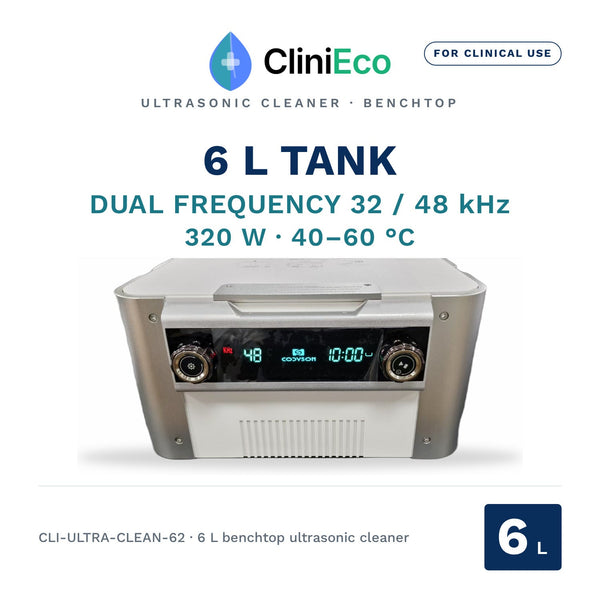
- Six-litre benchtop ultrasonic cleaner with dual frequency for pre-cleaning reusable instruments before disinfection or sterilization.
CliniEco Medical distributes clinic and studio consumables in Canada under MDEL #35334. This page describes requirements published by the Government of Ontario and by Health Canada; the requirement that binds a specific studio is the one in its provincial regulation, its municipal licensing conditions and its own written procedure.