
Exam Room Supplies
One clean patient station needs five things replaced or checked between patients: the paper on the table, a fresh bib, a clean surface for instruments, hand hygiene at the door and inside the room, and a waste receptacle that does not have to be touched. The supplies are inexpensive; the failure mode is running out mid-clinic and substituting something that was not designed for the room.
More about Exam Room Supplies
Everything that goes on or around the examination table: table paper, bed sheets, patient bibs, cotton rolls and swabs, tongue depressors, tape and dispensers.
What do exam rooms need for one clean patient station?
Public Health Ontario's infection prevention and control checklist for clinical office practice describes the room point by point. For examination and procedure rooms it asks whether there is access to alcohol-based hand rub or hand sanitizer with 60% to 90% alcohol both outside and inside the room, whether tissue boxes and hands-free waste receptacles are provided, and whether personal protective equipment is available where it is needed. Those three items, plus the paper on the table, are what a walk-through actually inspects.
The consumable list that satisfies the room is short. Table paper is replaced between patients on any surface the patient contacts. A patient bib is used where the clinic uses one, and it is a single-use item. Tape is a room item rather than a patient item, and it is the one supply that disappears from a drawer without anyone noticing. Hand hygiene at the door and at the point of care covers the entry requirement, and a hands-free dispenser removes the contact surface that a manual pump creates.
| Room item | Format | What it covers |
|---|---|---|
| Examination table paper | 18 inch or 21 inch width, 225 ft per roll, case of 12 rolls | The patient contact surface, replaced between patients |
| Perforated table paper | 21 inch by 125 ft, smooth, perforated, 9 per pack | Rooms where the paper is torn off at a fixed length rather than cut |
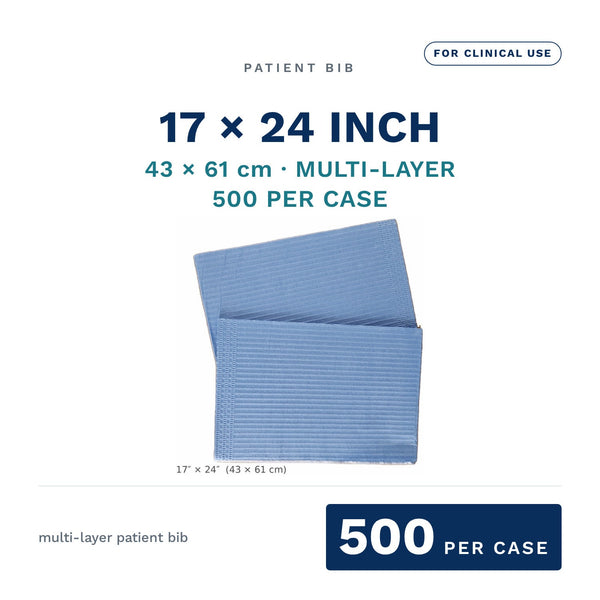
| Patient bibs | 17 by 24 inch, multi-layer, 500 per case, five colours | Single-use cover where the clinic uses a bib rather than paper alone |
| Hand hygiene | Touch-free dispenser at the door and at the point of care | The 60% to 90% availability item in the checklist |
| Waste | Hands-free receptacle within reach of the table | Disposal without a hand contact surface |
Which table paper and drape sizes / formats fit a single-physician clinic?
The deciding measurement is the width of the table, not the length of the roll. An 18 inch roll suits a narrow examination table, and a 21 inch roll is the format that covers a standard table with enough overhang at both edges that the paper does not slide off when a patient sits down. A clinic that orders one width for every room usually finds that the wider roll is being used on the narrow tables and cut down, which wastes more than the width difference suggests.
Length is a separate decision. A 225 ft roll is the format for a room where paper is pulled to a length and cut, and it carries roughly 2,700 inches per roll. A 125 ft perforated roll is the format for a room where the paper is torn at a printed interval, and it removes the step where someone estimates the length by eye. Both are available in cases of twelve rolls or packs of nine, and the difference in practice is how much paper each patient consumes rather than how much arrives.
Bibs are a size question with a colour question attached. A 17 by 24 inch multi-layer bib covers a seated adult without draping past the chair, and the five-colour option matters in a clinic that assigns a colour per room or per practitioner so that a bib left on a chair is traceable to the room it came from. A 500 per case count is the format that keeps a case in the storage room rather than a box in the corridor.
How do I keep cross-contamination under control without buying extra equipment?
Three changes to the paper and dispenser routine do most of the work, and none of them needs a machine. The first is to treat the paper as a per-patient item with a defined length, so that the replacement becomes a step in the room rather than a judgement. The second is to remove hand contact from the dispensers: a touch-free soap or sanitizer dispenser eliminates the surface that a manual pump shares between every person who uses it, which is the same logic the checklist applies when it asks for hands-free waste receptacles.
The third is to keep the supply in the room closed. Paper stored on an open shelf in a treatment room collects what the room collects, and a clinic that stores the case in a cupboard and brings out only the roll in use has separated clean stock from the room. The same rule applies to the refill path: a soap dispenser that is filled from a sealed pouch avoids the open-container question that a bulk decant creates.
What should a first order look like (quantity per station / per week)?
The arithmetic below assumes a single-physician clinic with two examination rooms, 20 patients a day and five clinic days a week, with paper replaced per patient at roughly 36 inches. It is arithmetic on that assumption rather than a standard, and a clinic with longer visits or a higher proportion of procedures should adjust the paper line first.
| Consumable | First order | How long it lasts at 20 patients a day |
|---|---|---|
| Table paper, 21 inch by 225 ft, case of 12 rolls | One case | About nine weeks at 36 inches per patient across two rooms |
| Perforated table paper, 21 inch by 125 ft, 9 per pack | One pack | Two to three weeks in the room where it is used |
| Patient bibs, 500 per case | One case | About one month where a bib is used for every patient |
| Hand soap or sanitizer refill | One refill per dispenser plus one spare | Depends on dispenser size; the label's in-use period governs |
Two rooms drawing on one case of paper is the detail that decides the reorder point. A clinic that reorders when the storage room looks empty has usually already run out in one room, because the two rolls in use are invisible in that judgement. Marking the case with the date it was opened fixes the guess.
Where do I reorder, and how fast does it ship in Canada?
Reorder from the product pages below, which show the case or pack count each item ships in, so the count received can be checked against the count ordered. Delivery time and freight depend on the destination and the weight of the shipment rather than on the item itself, and the confirmed figure is on the order confirmation rather than in a published table.
A clinic ordering paper, bibs and dispenser refills on separate weeks usually pays more in freight than it saves in storage, which is the argument for one combined order per quarter. Clinics that want a standing schedule rather than a series of small orders start from the institutional account enquiry page. Clinics in Quebec should confirm that any room instruction card the clinic prints itself is in French, since the Charter of the French language requires inscriptions supplied with a product, including directions for use, to be drafted in French.
What does an inspector look at in an exam room?
The walk-through follows the checklist items rather than the supply cupboard. Hand rub available outside and inside the room, a tissue box and a hands-free waste receptacle within reach, personal protective equipment where the clinic's routine practices require it, and a table surface that is visibly clean and covered for the next patient. The same checklist asks whether there are regular audits of infection control practices, which means the clinic's own dated observations of hand hygiene compliance are part of the evidence.
Paper and bibs rarely appear in an inspection finding on their own. What appears is the consequence of not having them: a table used without a cover, a bib reused, or a supply run out on the day of the visit. A par level written on the storage room wall, with the date the case was opened, is the smallest control that prevents all three.
Which items cover one exam room station?
- Smooth examination table paper, 21 inch by 225 ft, case of 12 rolls for the standard room width with edge overhang.
- Smooth examination table paper, 18 inch by 225 ft, case of 12 rolls for narrow tables where the wider roll would be cut down.
- Perforated examination table paper, 21 inch by 125 ft, smooth, 9 per pack for rooms that tear at a fixed length.
- Patient bibs, 17 by 24 inch, multi-layer, 500 per case in five colours as the single-use cover where the clinic uses one.
- Touch-free foam soap dispenser, 1200 ml sealed-pouch, wall mounted for hand hygiene at the room entrance.
CliniEco Medical distributes clinic consumables in Canada under MDEL #35334. This page describes requirements and guidance published by Public Health Ontario and by Health Canada; the requirement that binds a specific clinic is the one in its provincial guidance and its own written policy.